


Human plasma in the production of medicinal products: national differences in terms of harmonization with global compendial requirements

https://doi.org/10.30895/2221-996X-2026-26-1-28-41

Abstract
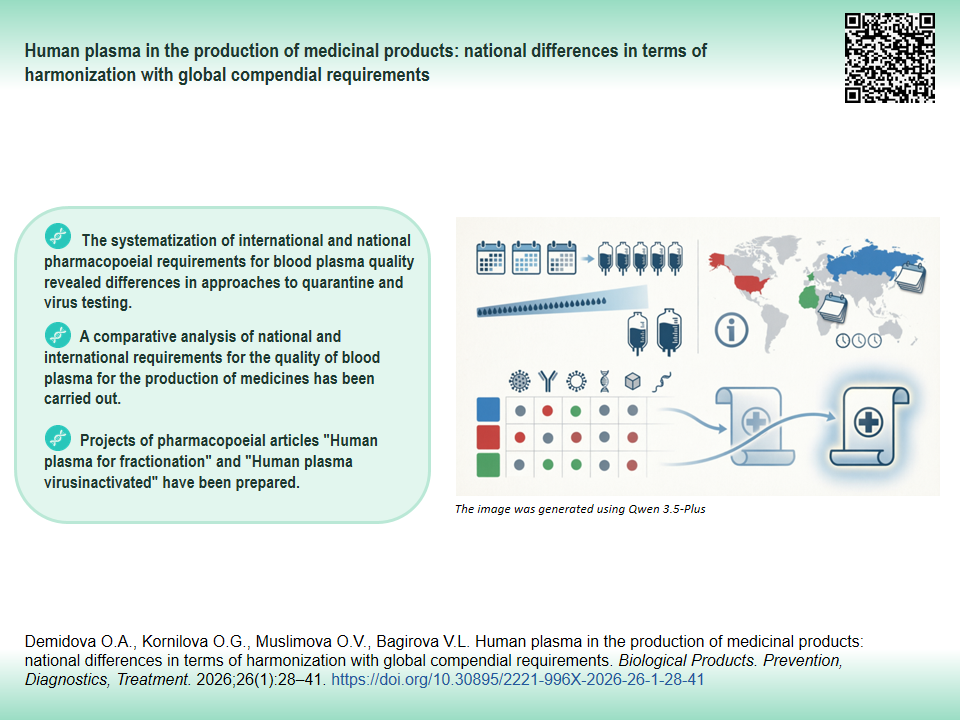
INTRODUCTION. Plasma-derived medicinal products (PDMPs) are used to treat a number of systemic diseases, immunodeficiency disorders, and life-threatening conditions. The growing PDMP consumption necessitates the scaling of production and the provision of a stable supply of plasma, with the quality meeting international standards.
AIM. This study aimed to systematize and analyze national and international compendial requirements for the quality of human plasma, including that used for PDMP production, within harmonization process of national requirements with global quality standards for the development of draft pharmacopeial monographs.
DISCUSSION. Analyzed regulatory documents and scientific literature revealed that plasma donation rates per donor ranged from 24 to 104 times per year in various countries, while acceptable donation volumes ranged from 650 to 850 mL. A two-stage donor selection system based on the results of two consecutive laboratory tests ensures high viral safety of medicinal products, which complies with international standards, including those of Plasma Protein Therapeutics Association. In the Russian Federation, the mandatory quarantine period for human blood plasma is 120 days. In the United States, plasma producers have voluntarily implemented a 60-day plasma quarantine protocol for further production. In France, plasma quarantine also lasts for two months. Analyzed viral safety control and assurance of individual donations, minipools, and fractionation pools (FPs) for viral markers in the national and regional quality standards revealed different approaches to standardization. The European and Indian Pharmacopoeias require testing of individual plasma donations for antibodies to HIV-1 and HIV-2, hepatitis C virus (HCV), and HBsAg. The US Code of Federal Regulations requires testing of individual plasma donations for HBsAg, antibodies to HIV-1, HIV-2, HCV, and HIV and HCV nucleic acids. The State Pharmacopoeia of the Russian Federation (SP RF) requires testing of each individual plasma donation for HBsAg, antibodies to HCV, HIV-1 p24 antigen, antibodies to HIV-1 and HIV-2, and the Treponema pallidum. As part of harmonizing SP RF with the monographs of foreign pharmacopoeias, requirements were established for the quality of human plasma, including that used for PDMP production.
CONCLUSIONS. The results of a comparative analysis of national and international quality requirements for fractionated plasma and virus-inactivated human plasma indicate the need to develop modern approaches to standardization and quality control. Draft pharmacopoeial monographs Human plasma for fractionation and Human virus-inactivated plasma have been prepared.
Keywords
standardization,
human blood plasma,
donors,
quarantine,
individual donations,
plasma pools,
viral safety,
general pharmacopoeial monograph,
harmonization,
State Pharmacopoeia of the Russian Federation,
European Pharmacopoeia
Funding: This study was conducted by the Scientific Centre for Expert Evaluation of Medicinal Products as part of the applied research funded under State Assignment No. 056-00061-26-00 (R&D Registry No. 124022200096-0)
About the Authors
О. A. Demidova
Scientific Centre for Expert Evaluation of Medicinal Products
Russian Federation
Russian Federation
Olga A. Demidova, Cand. Sci. (Pharm.)
8/2 Petrovsky Blvd, Moscow 127051
O. G. Kornilova
Scientific Centre for Expert Evaluation of Medicinal Products
Russian Federation
Russian Federation
Olga G. Kornilova, Dr. Sci. (Pharm.)
8/2 Petrovsky Blvd, Moscow 127051
O. V. Muslimova
Scientific Centre for Expert Evaluation of Medicinal Products
Russian Federation
Russian Federation
Olga V. Muslimova, Cand. Sci. (Med.)
8/2 Petrovsky Blvd, Moscow 127051
V. L. Bagirova
Scientific Centre for Expert Evaluation of Medicinal Products
Russian Federation
Russian Federation
Valeria L. Bagirova, Dr. Sci. (Pharm.), Prof.
8/2 Petrovsky Blvd, Moscow 127051
References
1. Wilson BE, Freman CM. Immunoglobulin therapy for immunodeficiency. Allergy Asthma Proc. 2024;45(5):364–70. https://doi.org/10.2500/aap.2024.45.240053
2. Mukhina AA, Abramova IN, Kuzmina NB, et al. Immunoglobulin replacement therapy in patients with primary immunodeficiency diseases in Russia. Pediatric Hematology/Oncology and Immunopathology. 2020;19(4 suppl):18–29 (In Russ.). https://doi.org/10.24287/1726-1708-2020-19-4suppl-18-29
3. Gröning R, Walde J, Ahlm C, et al. Intravenous immunoglobulin therapy for COVID-19 in immunocompromised patients: A retrospective cohort study. Int J Infect Dis. 2024;144:107046. https://doi.org/10.1016/j.ijid.2024.107046
4. Farrugia A, Bansal M, Marjanovic I. Estimation of the latent therapeutic demand for immunoglobulin therapies in autoimmune neuropathies in the United States. Vox Sang. 2021;117(2):208–19. https://doi.org/10.1111/vox.13134
5. Nathwani AC. Gene therapy for hemophilia. Hematology Am Soc Hematol Educ Program. 2022(1):569–88. https://doi.org/10.1182/hematology.2022000388
6. Makhmudova MR. International experience in the preparation of blood plasma for fractionation. Journal of Theoretical and Clinical Medicine. 2022;(5):109–12 (In Russ.). EDN: QYAZRN
7. Prevot J, Jolles S. Global immunoglobulin in supply: Steaming towards the iceberg? Curr Opin Allergy Clin Immunol. 2020;20(6):557–64. https://doi.org/10.1097/ACI.0000000000000696
8. Bhatnagar S, Burnouf T, Prevot J, et al. Navigating the Asia-Pacific region plasma therapies landscape: Insights from the 2023 Asia-Pacific Plasma Leaders’ Network meetings. Vox Sang. 2024;119(11):1207–13. https://doi.org/10.1111/vox.13725
9. Schreiber GB, Kimber MC. Source plasma donors: A Snapshot. Transfusion. 2017;57(Supplement S3):110A. https://doi.org/10.13140/RG.2.2.32748.87683
10. Strengers PFW. Challengers for plasma-derived medicinal products. Transfus Med Hemother. 2023;50(2):116–22. https://doi.org/10.1159/000528959
11. Paramonov IV, Poptsov AL, Rylov AV. Experience of implementing a system of qualification plasma for fractionation donors. Russian Journal of Hematology and Transfusiology. 2016;61(2):87–91 (In Russ.). EDN: VZVYCB
12. Paramonov IV. Assessment of the infection safety and plasma quality system for plasma fractionation. Medical Newsletter of Vyatka. 2016;(4):76–84 (In Russ.). EDN: YFZWCV
13. Chemodanov IG, Cherkasov SN, Madzaev SR, Zhiburt EB. About length of donor plasma quarantine. Bulletin of Semashko National Research Institute of Public Health. 2018;(1):80–5 (In Russ.). EDN: XREABF
14. Garraud O, Martinaud C. The plasma supply in France. Transfus Apher Sci. 2019;58(4):358–62. https://doi.org/10.1016/j.transci.2019.06.004
15. Fiedler SA, Oberle DF, Henseler O, et al. Follow-up of plasma donors after quarantine storage: Results of a 5-years survey in Germany. Transfus Med Hemother. 2022;50(1):26–9. https://doi.org/10.1159/000525747
16. Klanderman RB, van Mourik N, Eggermont D, et al. Incidence of transfusion-related acute lung injury temporally associated with solvent/detergent plasma use in the ICU: A retrospective before and after implementation study. Transfusion. 2022;62(9):1752–62. https://doi.org/10.1111/trf.17049
17. Gubanova MN, Chemodanov IG, Gaivoronskaya VV, et al. Inactivation of pathogens in cellular components. Transfusiology. 2017;18(3):15–36 (In Russ.). EDN: UWRLFE
18. Kaur G, Kaur P. Syphilis testing in blood donors: an update. Blood Transfus. 2015;13(2):197–204. https://doi.org/10.2450/2014.0146-14
19. D`aes T, van de Sande D, Buck ED, et al. Does cold storage of blood before transfusion prevent the transmission of syphilis? A systematic review and meta-analysis. Vox Sang. 2024;119(3):219–31. https://doi.org/10.1111/vox.13554
20. Farrugia A. Plasma for fractionation: Safety and quality issues. Haemophilia. 2004;10(4):334–40. https://doi.org/10.1111/j.1365-2516.2004.00911.x
Supplementary files

|
1. Table S1. Comparative analysis of viral marker testing of individual donations, minipools, and a production pool of human plasma for fractionation | |
| Subject | ||
| Type | Исследовательские инструменты | |
Download
(716KB)
|
Indexing metadata ▾ | |
Review
For citations:
Demidova О.A., Kornilova O.G., Muslimova O.V., Bagirova V.L. Human plasma in the production of medicinal products: national differences in terms of harmonization with global compendial requirements. Biological Products. Prevention, Diagnosis, Treatment. 2026;26(1):28-41. (In Russ.) https://doi.org/10.30895/2221-996X-2026-26-1-28-41
Views:
1786
JATS XML





 Email this article