


ISSUE TOPIC: mRNA TECHNOLOGIES IN BIOMEDICINE: CURRENT ADVANCES AND REGULATORY PRACTICE
INTRODUCTION. The platform approach, which involves the use of an unchanged manufacturing process and standardized quality control methods, is recognized by leading regulatory authorities, such as the Food and Drug Administration (FDA) and the European Medicines Agency (EMA), as an effective tool for accelerating market entry of innovative products, namely mRNA vaccines and gene therapy products. In this context, the implementation of this concept is relevant for the Russian Federation and the countries of the Eurasian Economic Union (EAEU), as it would accelerate pharmaceutical development, optimize quality control and process validation, and improve regulatory review during the registration of such products.
AIM. This study aimed to analyze international regulatory approaches to the application of platform technologies in the manufacturing and quality control of mRNA vaccines and gene therapy products based on viral vectors and genome editing systems, in order to provide a rationale for their implementation in the national legislation and regulatory documentation of the Russian Federation and the EAEU.
DISCUSSION. An analysis of publications from 2015 to 2025 in the PubMed, Google Scholar, and eLIBRARY.ru databases, as well as official documents from regulatory authorities, including the FDA, the EMA, the World Health Organization (WHO), the International Council for Harmonisation of Technical Requirements for Pharmaceuticals for Human Use (ICH), the Medicines and Healthcare products Regulatory Agency, and the Pharmaceuticals and Medical Devices Agency (PMDA), addressing the application of platform technologies in the manufacturing and quality control of medicinal products, was performed. It was found that the regulatory documentation of the Russian Federation and the EAEU lacks criteria for applying the platform approach to mRNA vaccines and gene therapy products, which hinders the accelerated introduction of innovative personalized medicinal products into clinical practice. International regulatory approaches (FDA, EMA, PMDA) were shown to accelerate development and process validation, and reduce the scope of preclinical studies and clinical trials through the reuse of data on previously manufactured and approved products (including data on the manufacturing process and safety profiles for mRNA vaccines and gene therapy products). The main unresolved issues remain the amount of supporting data and the need for a first approved product before platform technology status can be granted. The need to develop unified regulatory requirements for relevant experience and process validation was substantiated, which would allow the benefits of the platform approach to be realized while maintaining a high level of safety and efficacy of medicinal products during regulatory review.
CONCLUSIONS. The platform approach, based on an unchanged manufacturing process and standardized quality control methods, can accelerate pharmaceutical development, reduce the extent of preclinical studies and clinical trials, and optimize the regulatory review of mRNA vaccines and gene therapy products. To implement this approach in the Russian Federation and the EAEU, it is necessary to incorporate provisions into the regulatory documentation allowing the use of standardized modules within a single technological platform, which would accelerate the development and market launch of gene therapy products and personalized products, and increase their affordability.
INTRODUCTION. Oligonucleotides represent a promising class of drugs with unique physicochemical properties, pharmacokinetic characteristics, mechanisms of action, and encouraging therapeutic potential. Due to the lack of a national Russian guideline and a guideline currently effective within the Eurasian Economic Union (EAEU), existing international regulatory requirements for the preclinical safety assessment of oligonucleotides were reviewed.
AIM. To analyze regulatory documents and scientific and methodological sources addressing current approaches to the preclinical development of therapeutic oligonucleotides.
DISCUSSION. Oligonucleotides represent an established class of medicinal products consisting of chemically synthesized compounds that are polymorphic in structure and mechanism of action, possessing highly specific pharmacological activity. The pharmacological action of oligonucleotides is based on the specific binding of synthetically modified RNA or RNA/DNA hybrids to target RNA sequences to alter RNA expression and/or subsequent protein expression. Oligonucleotides can vary by mechanism of action, structure, chemical modifications, size, sequence, delivery strategy, as well as by the presence or absence of other functional groups, such as small molecules, proteins, or antibodies. In terms of target and species specificity, these drugs occupy an intermediate position between small molecules and biologics. Currently, antisense oligonucleotides, small interfering RNAs, and aptamers are successfully utilized in clinical practice. Local guidelines for the preclinical safety assessment of oligonucleotides proposed by the Pharmaceuticals and Medical Devices Agency (PMDA), the US Food and Drug Administration (FDA), and the European Medicines Agency (EMA) serve as an interim step prior to the release of the globally harmonized International Council for Harmonisation (ICH) S13 guideline, which is currently being developed by international regulators. In accordance with the Fundamental Scientific Research Program in the Russian Federation for the 2021–2030 period, which states the goal of creating technologies for silencing damaged genes using oligonucleotides, the development of a guideline for the preclinical studies of oligonucleotides is considered appropriate.
CONCLUSIONS. Therapeutic oligonucleotides have a dual nature, combining the characteristics of small chemical molecules and highly specific biotechnological products. Since oligonucleotide development is a dynamically evolving scientific field, it is advisable to utilize a flexible, case-by-case approach when planning and conducting preclinical studies. This approach should account for chemical modification, mechanism of action, delivery method, and current scientific knowledge regarding the potential toxic effects of this drug class.
INTRODUCTION. The highly pathogenic avian influenza virus subtype H5Nx is rapidly evolving and infecting various species of wild and domestic mammals, including cattle, highlighting its pandemic potential for humans. To combat the pandemic threat, it is essential to develop suitable vaccine platforms, including mRNA vaccines, the efficacy of which largely depends on the delivery system. This study evaluates the immunogenicity and protective efficacy of the mRNA-H5 vaccine, delivered via lipid nanoparticles (LNPs) and jet injection (JI).
AIM. The aim of the study was to evaluate the immunogenic and protective properties of the experimental mRNA-H5 vaccine in a ferret model.
MATERIALS AND METHODS. Ferrets were immunized twice with the mRNA-H5 vaccine at a dose of 30 μg formulated with LNPs and at a dose of 100 μg administered by JI. Sera from immunized ferrets were analyzed using an enzyme-linked immunosorbent assay (ELISA) against the recombinant HA/H5 protein, an enzyme-linked immunospot (ELISpot) assay using a pool of specific peptides, and a virus neutralization assay in MDCK-SIAT1 cell culture using the influenza virus strain A/turkey/Stavropol/320-01/2020 (H5N8). Immunized ferrets were intranasally challenged with 5 LD50 of the influenza virus strain A/dalmatian pelican/Kalmykia/ 330-10V/2023 (H5N1), and their status was recorded for 14 days after challenge.
RESULTS. Using ELISA, it was established that specific antibody titers were determined in groups of animals immunized with the mRNA-H5 vaccine administered by JI or formulated with LNPs; the average titers in the groups were 1:180,000 and 1:4,000,000, respectively. Using the virus neutralization assay, sera from animals immunized with the mRNA-H5 vaccine administered by JI or formulated with LNPs had virus-neutralizing activity; the average 50% neutralizing titers were 1:250 and 1:1500, respectively. The ELISpot assay showed that in groups of ferrets immunized with the mRNA-H5 vaccine, specific cellular immunity was induced. Immunization with the mRNA-H5 vaccine provided 100% protection against mortality in ferrets challenged with 5 LD50 of the influenza virus strain A/dalmatian pelican/Kalmykia/330-10V/2023 (H5N1).
CONCLUSIONS. This study demonstrated the effective induction of virus-specific humoral and cellular immune responses in ferrets immunized with the mRNA-H5 vaccine administered by JI or formulated with LNPs.
INTRODUCTION. Despite the effectiveness of existing COVID-19 vaccines, the emergence of new SARS-CoV-2 variants necessitates the development of immunogens capable of eliciting a broad, cross-reactive immune response. A promising approach is the development of mRNA vaccines that induce both humoral and T-cell responses, which could provide protection against viral variants that evade neutralizing antibodies.
AIM. This study aimed to investigate the immunogenicity of an experimental two-component mRNA vaccine encoding an artificial multi-epitope T-cell immunogen and the receptor-binding domain (RBD) of the SARS-CoV-2 spike protein, to demonstrate the potential of this vaccine to elicit a broad, cross-reactive response required for effective protection against highly variable viruses.
MATERIALS AND METHODS. The mRNAs were synthesized in vitro: mRNA-RBD encoded the RBD, and mRNA-BSI encoded the multi-epitope T-cell immunogen. The vaccine mRNA was encapsulated in lipid nanoparticles (LNPs); particle size was assessed using dynamic light scattering. BALB/c mice (24 females) were divided into 4 groups of 6 animals each. For immunization, 10 μg of mRNA-LNP (either alone or as a mixture of the two constructs) was administered intramuscularly twice, 3 weeks apart. Humoral response was evaluated by titers of virus-specific and neutralizing antibodies; T-cell response was assessed by ELISpot (spot-forming units, SFUs), sandwich ELISA, intracellular cytokine staining, and flow cytometry.
RESULTS. The LNPs encapsulating the vaccine mRNA had a size of 115.4–123.7 nm and a low polydispersity index (0.165–0.211). The two-component vaccine (mRNA-RBD + mRNA-BSI) induced high titers of RBD-specific antibodies (1:131,322) and neutralizing antibodies against the Wuhan-Hu-1 strain (1:3,620) and the Omicron BA.5.2 strain (1:718). The T-cell response in the two-component vaccine group was characterized by high IFN-γ production: the number of IFN-γ-producing lymphocytes and the IFN-γ concentration in splenocyte culture were 660 SFUs/million cells (ELISpot) and 990 pg/mL (ELISA), respectively; both significantly exceeded the corresponding values in the mRNA-RBD group (343 SFUs/million and 60 pg/mL, respectively). Intracellular staining revealed an increased proportion of cytokine-producing CD4+ and CD8+ T cells (IFN-γ, IL-2, TNF-α) in all immunized groups.
CONCLUSIONS. The combination of B-cell and T-cell immunogens in a two-component mRNA vaccine enhances the humoral response and promotes a broad T-cell response, ensuring effective recognition of emerging SARS-CoV-2 variants. The data support the potential of this platform for the development of vaccines against highly variable viral infections.
INTRODUCTION. The low physicochemical stability of mRNA and the dependence of current mRNA vaccines on the successful encapsulation into lipid nanoparticles and adherence to mandatory cold chain requirements limit their storage and transportation. A promising approach is the lyophilization of nonencapsulated mRNA with its subsequent delivery by jet injection. However, the preservation of its structure and functional activity during long-term storage has been insufficiently studied.
AIM. To evaluate the structural and functional stability of lyophilized nonencapsulated mRNA during long-term storage and its immunogenicity as a component of a trivalent mRNA vaccine against seasonal influenza administered to mice by jet injection.
MATERIALS AND METHODS. mRNA encoding green fluorescent protein (GFP) was lyophilized with various cryoprotectants and stored at −20, 4, and 20 °C. Its functional activity was determined by GFP expression after transfection of HEK293 cells, and its integrity was analyzed by microchip electrophoresis. The immunogenicity of the lyophilized and nonlyophilized mRNA-Vector-Flu vaccine was evaluated in female inbred BALB/c mice after two jet immunizations by enzyme-linked immunosorbent assay (ELISA), hemagglutination inhibition (HAI) assay, virus neutralization assay, and interferon gamma (IFN-γ) enzyme-linked immunospot (ELISpot) assay.
RESULTS. Based on the results of a preliminary screening, a 10% trehalose formulation was selected for further studies because it preserved the functional activity of GFP mRNA at the level closest to that of the control preparation. The lyophilized GFP mRNA retained its functional activity after 12 months of storage at all tested temperatures; no statistically significant differences were found compared with the mRNA synthesized immediately before use (p>0.05). The major mRNA fraction was preserved, although minor fractions of partially degraded mRNA were detected after 6–12 months, particularly at 20 °C. After 3 months of storage of the vaccine at 4 °C, the geometric mean antibody titers against hemagglutinin subtype 1 (H1), hemagglutinin subtype 3 (H3), and influenza B hemagglutinin (HB) were 1:382,000, 1:628,000, and 1:273,000, respectively, compared with 1:710,000, 1:628,000, and 1:328,000 in the nonlyophilized vaccine group. HAI titers were 1:37–1:80, virus-neutralizing antibody titers were 1:50–1:90; and the numbers of IFN-γ-secreting cells were 440 and 500 spot-forming cells (SFC) per 1×10⁶ splenocytes. No significant between-group differences were identified.
CONCLUSIONS. Lyophilization with 10% trehalose preserved the functional activity of nonencapsulated mRNA for 12 months despite signs of partial degradation at 20 °C. After 3 months of storage at 4 °C, the trivalent vaccine retained its ability to induce humoral and T-cell immune responses in mice. These findings support the potential of combining lyophilization and jet injection for the development of stable mRNA vaccines.
INTRODUCTION. The mRNA platform technology for creating vaccines against infectious diseases was introduced into clinical practice during the COVID-19 pandemic; however, the accumulated experience of clinical use of mRNA vaccines requires systematization in relation to other infectious diseases. Therefore, summarizing data on the efficacy and safety of such mRNA vaccines in controlled clinical trials is relevant for substantiating approaches to the regulatory evaluation of immunobiological medicinal products of this class.
AIM. To review the results of clinical trials of mRNA vaccines for the prevention of respiratory syncytial virus infection (RSV infection), cytomegalovirus infection (CMV infection), seasonal influenza, Zika fever, and rabies to summarize data on their efficacy and safety, identifying the limitations associated with the use of surrogate endpoints and sample size.
DISCUSSION. The authors analyzed publications in PubMed, eLIBRARY.RU and records in ClinicalTrials.gov describing the results of controlled clinical trials of mRNA vaccines for the prevention of infectious diseases (excluding COVID-19) from 2016 to 2026. Clinical efficacy was confirmed only for the mRNA-1345 vaccine against RSV infection: 83.7% (for episodes with 2 symptoms) and 82.4% (for episodes with 3 symptoms); the safety profile was considered satisfactory. For mRNA vaccines against seasonal influenza, a favorable safety profile and pronounced seroconversion in the hemagglutination inhibition assay were confirmed; the humoral immunity parameters were comparable to those of licensed vaccines. The mRNA-1647 vaccine against CMV infection, after a three-dose regimen, induced a durable immune response with the activation of T-cell immunity, along with a favorable safety profile. In a study of vaccines for the prevention of Zika fever (mRNA-1325, mRNA-1893), the presence of neutralizing antibodies (in a neutralization assay) after vaccination was demonstrated in participants with different baseline flavivirus serostatus; the safety profile was considered favorable. The mRNA vaccine CV7201 against rabies induced protective titers of virus-neutralizing antibodies in 71% of study participants after intradermal administration and in 46% after intramuscular administration; the incidence of local and systemic adverse events (AEs) was high (97% and 78%, respectively). Most studies were shown to have limitations associated with the assessment of efficacy using surrogate endpoints and an insufficient sample size to detect rare adverse events.
CONCLUSIONS. The results of controlled clinical trials of mRNA vaccines for the prevention of RSV and CMV infection, seasonal influenza, Zika fever, and rabies demonstrated their potential efficacy and acceptable safety profile; however, the evaluation of most products is based on surrogate endpoints and small sample sizes, which are the main limitations of the conducted studies. The findings substantiate the need for further research using endpoints (clinical efficacy, surrogate markers) and post-marketing safety monitoring (primarily for local and systemic AEs).
VACCINE PROPHYLAXIS AGAINST INFECTIOUS DISEASES
INTRODUCTION. Hantavirus fevers, known as hemorrhagic fever with renal syndrome (HFRS) in Eurasia and hantavirus pulmonary syndrome (HPS) in the Americas, are natural focal diseases with a wide range of clinical manifestations. The causative agents are members of the genus Orthohantavirus, whose natural reservoirs are rodents of various species. There is currently no etiotropic therapy for these diseases. Specific prophylaxis through vaccination is available only in the DPRK, the Republic of Korea, and the People's Republic of China. An important objective is to provide the Russian and European markets with a relevant vaccine for HFRS prevention. Such a vaccine should be developed based on both time-proven approaches and the experience of modern developments.
AIM. Analysis of the use of existing hantavirus vaccines and the specific features of vaccines under development, as well as assessment of the prospects for creating vaccines for HFRS prevention in the Russian Federation.
DISCUSSION. All commercially available vaccine preparations are inactivated whole-virion vaccines based on the Hantaan and Seoul viruses. The effectiveness of these preparations varies, but a significant reduction in the incidence rate in regions with mass vaccination and a low incidence of adverse events have been noted. Several inactivated whole-virion vaccines based on relevant orthohantavirus strains have been developed in Russia. Some of these developments have successfully completed preclinical studies. The spectrum of hantavirus vaccine preparations under development includes subunit vaccines, vaccines based on virus-like particles (VLPs) and viral vectors, DNA vaccines, and mRNA vaccines. The primary immunogens are the surface glycoproteins Gn and Gc of hantaviruses. The closest to implementation into clinical practice are the DNA vaccines based on the Puumala and Hantaan viruses, which have undergone clinical trials (phase I).
CONCLUSIONS. No vaccine for the prevention of hantavirus infections developed using virus-like particles (VLPs), viral vectors, or nucleic acids (DNA or mRNA) has undergone a full cycle of clinical trials or been licensed worldwide. On the contrary, well-established traditional technologies for manufacturing inactivated vaccines and their time-proven effectiveness provide a basis for their real prospects of practical application in the Russian Federation and other European countries.
STANDARDIZATION AND QUALITY CONTROL

INTRODUCTION. Spontaneous mutations often arise and accumulate in the genome of RNA-containing viruses, for example measles, rubella and mumps. Modern requirements for the production of vaccine products containing live vaccine viruses suggest control of the genetic stability of production strains. The method of high throughput sequencing allows to determine all mutations arisen in viral population, and to assess genetic stability of production strains.
AIM. Analysis of nucleotide sequence of the genomes of seed and production strains of measles (Leningrad-16), rubella (RA27/3) and mumps (Leningrad-3) viruses, in comparison with the reference nucleotide sequences of vaccine strains genomes (submitted in the Gen-Bank database).
MATERIALS AND METHODS. Production strains of vaccines (measles culture live, rubella culture live and mumps culture live) were used in this study. Whole genome sequencing was performed using the MGI DNBSEQ G-400 and Illumina NextSeq2000 genetic analyzers. When processing and analyzing the sequencing data, the following programs and tools were used: FastQC v.0.12.1, FastP v.0.23.4, BWA-MEM2 v.2.2.1, VizCoV tool.
RESULTS. Analysis of single nucleotide polymorphisms (SNPs) within the viral population in the studied samples revealed a number of minor variants that, and after further accumulation, may lead to changes in the consensus sequences of the vaccine strains proteins. For the studied measles virus samples, no SNPs were found in the main measles virus antigen H protein, however, a nonsynonymous polymorphism was detected in the F protein, occurring in 30.0–40.9% of the viral genomes. SNPs were found in the capsid protein C and in the surface glycoprotein E2 rubella virus, occurring in the viral population with a frequency of up to 30%. SNPs were found in surface antigens hemagglutinin neuraminidase HN and fusion protein F of mumps virus, occurring in the genomes of less than 20% of viral population. Mutations in the genomes of production strains that could affect the immunogenicity of measles, rubella, and mumps vaccines were not detected.
CONCLUSIONS. The identified set of minor variants with a frequency of occurrence in viral population of more than 10%, which, with further accumulation, can lead to changes in the consensus sequences of vaccine strains, makes the monitoring of vaccine strains stability using high-throughput sequencing relevant.
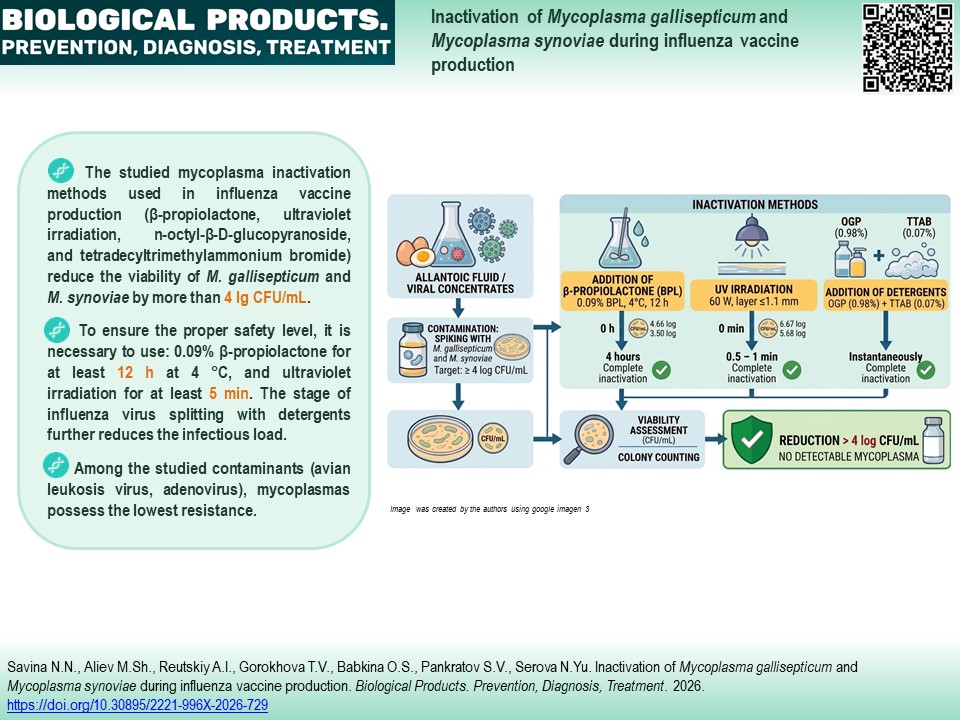
INTRODUCTION. The use of chicken embryos in influenza vaccine production carries the risk of contaminating the final product with the avian mycoplasmas, Mycoplasma gallisepticum and M. synoviae, which pose a potential hazard to humans. Therefore, evaluating the effectiveness of inactivating these contaminants in influenza vaccine intermediates using inactivators (β-propiolactone, ultraviolet irradiation) and detergents is important.
AIM. This study aimed to evaluate the inactivation dynamics of M. gallisepticum and M. synoviae in influenza vaccine intermediates following exposure to β-propiolactone, ultraviolet irradiation, and detergents (n-octyl-β-D-glucopyranoside, tetradecyltrimethylammonium bromide) to determine their effectiveness under vaccine production conditions.
MATERIALS AND METHODS. M. synoviae strain WVU1853 (ATCC) and M. gallisepticum (VGNKI) were used. To assess inactivation dynamics, influenza vaccine intermediates containing human influenza virus were spiked with mycoplasma cultures at a concentration of at least 4 lg CFU/mL. Inactivation was performed under the following conditions: 0.09% β-propiolactone at 4 °C for 12 hours; ultraviolet irradiation (60 W) with a layer thickness of the contaminated intermediates ≤1.1 mm for 5 min; 0.98% n-octyl-β-D-glucopyranoside and 0.07% tetradecyltrimethylammonium bromide at 18 °C for 60 min. The concentrations of M. gallisepticum and M. synoviae in the test samples were determined by the colony-forming unit (CFU) assay.
RESULTS. Immediately after β-propiolactone addition, the concentration of M. gallisepticum decreased by 1.88±0.20 lg CFU/mL, and that of M. synoviae decreased by 2.17±0.37 lg CFU/mL. After 4 hours of inactivation, no viable mycoplasmas of either species were detected. Under ultraviolet irradiation, viable M. gallisepticum were not detected after 1 min, and M. synoviae were not detected after 0.5 min. No viable M. gallisepticum or M. synoviae were detected immediately after the addition of detergents (n-octyl-β-D-glucopyranoside or tetradecyltrimethyl-ammonium bromide).
CONCLUSIONS. All studied mycoplasma inactivation methods used in influenza vaccine production (β-propiolactone, ultraviolet irradiation, n-octyl-β-D-glucopyranoside, and tetradecyltrimethylammonium bromide) reduce the viability of M. gallisepticum and M. synoviae by more than 4 lg CFU/mL. The described approaches for assessing the inactivation dynamics of avian mycoplasmas can be used to study the resistance of other contaminants to various inactivation methods and chemical reagents.
CLARIFICATIONS OF REGULATORY REQUIREMENTS AND NORMATIVE ACTS

ISSN 2619-1156 (Online)





