


Lipooligosaccharide in whole-cell pertussis vaccines: Correlation of its content with specific safety parameters in mice
 I. A. Alekseeva,
O. V. Shapovalova,
G. A. Sapozhnikova,
N. P. Neugodova,
D. N. Lepikhova,
I. V. Ibragimkhalilova
I. A. Alekseeva,
O. V. Shapovalova,
G. A. Sapozhnikova,
N. P. Neugodova,
D. N. Lepikhova,
I. V. Ibragimkhalilova https://doi.org/10.30895/2221-996X-2026-26-2-230-240

Abstract
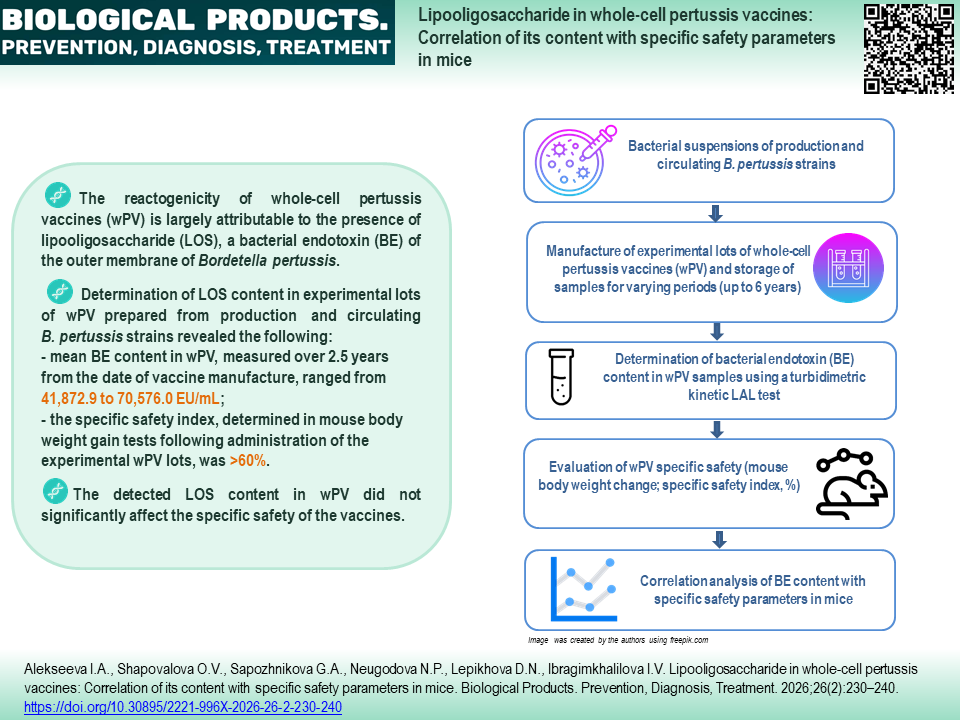
INTRODUCTION. The reactogenicity of whole-cell pertussis vaccines (wPV) is largely attributable to the presence of lipooligosaccharide (LOS), a bacterial endotoxin (BE) from the outer membrane of Bordetella pertussis. Assessing the LOS content in wPV and its correlation with specific safety parameters would help establish an acceptable LOS level that does not increase reactogenicity.
AIM. This study aimed to determine the lipooligosaccharide content in whole-cell pertussis vaccines and establish its correlation with specific safety parameters in mice (body weight change and specific safety index).
MATERIALS AND METHODS. Experimental batches of wPV manufactured from production strains (38, 475, 703) and from B. pertussis circulating strains (1-20, 2-20, 16-16, 25-16, 28(1)-18, 30-18, 33-18), isolated from children with pertussis, were studied. BE content was measured using the gel-clot test and the turbidimetric method. Specific safety parameters were assessed 24 hours and 7 days after administration by monitoring body weight changes in outbred mice of both sexes and by calculating the specific safety index (%).
RESULTS. BE content was determined at three time intervals: within 1 year after wPV manufacture (prior to combining with other diphtheria, tetanus, and pertussis (DTP) vaccine components); from 1 to 2.5 years (shelf life of wPV as part of the DTP vaccine); and from 2.5 to 6 years (after expiry). Mean BE content in wPV from circulating strains stored for 1 year and for 1–2.5 years ranged from 41,872.9 to 70,576.0 EU/mL; in wPV from the production strain stored for 1–2.5 years, it was 43,980.6 EU/mL. Vaccines stored for 2.5–6 years showed mean BE values ranging from 1353.8 to 26,655.0 EU/mL. A wide range of BE content was observed across manufactured batches, varying from <1000–1270 EU/mL (strain 30-18) to 36,430–94,270 EU/mL (strain 703). Specific safety index values for all samples, except for the freshly prepared 16-16 and 33-18, were >60%. A moderate inverse correlation was found between BE content and both mouse body weight change and the specific safety index.
CONCLUSIONS. BE content did not differ statistically between wPV samples stored for 1 year and those stored for 1–2.5 years. The specific safety index values (>60%) indicate that the BE levels comply with safety requirements. The inverse correlation between BE content (in vitro) and the specific safety index (in vivo) confirms the role of LOS in the specific toxicity of the vaccine, supporting further investigation into its levels in B. pertussis strains and its impact on wPV safety.
Keywords
pertussis,
Bordetella pertussis,
whole-cell pertussis vaccine,
lipooligosaccharide,
bacterial endotoxin,
circulating strains,
LAL test,
TAL test,
reactogenicity,
specific safety
Funding: This study was conducted at the Scientific Centre for Expert Evaluation of Medicinal Products as part of the applied research funded under State Assignment No. 056-00061-26-00 (R&D state registration No. 124022200103-5)
About the Authors
I. A. Alekseeva
Scientific Centre for Expert Evaluation of Medicinal Products
Russian Federation
Russian Federation
Irina A. Alekseeva, Dr. Sci. (Med.)
8/2 Petrovsky Blvd., Moscow 127051
O. V. Shapovalova
Scientific Centre for Expert Evaluation of Medicinal Products
Russian Federation
Russian Federation
Olga V. Shapovalova, Cand. Sci. (Pharm.)
8/2 Petrovsky Blvd., Moscow 127051
G. A. Sapozhnikova
Scientific Centre for Expert Evaluation of Medicinal Products
Russian Federation
Russian Federation
Galina A. Sapozhnikova
8/2 Petrovsky Blvd., Moscow 127051
N. P. Neugodova
Scientific Centre for Expert Evaluation of Medicinal Products
Russian Federation
Russian Federation
Nataliia P. Neugodova, Cand. Sci. (Biol.)
8/2 Petrovsky Blvd., Moscow 127051
D. N. Lepikhova
Scientific Centre for Expert Evaluation of Medicinal Products
Russian Federation
Russian Federation
Darya N. Lepikhova
8/2 Petrovsky Blvd., Moscow 127051
I. V. Ibragimkhalilova
Scientific Centre for Expert Evaluation of Medicinal Products
Russian Federation
Russian Federation
Ilkhamya V. Ibragimkhalilova, Cand. Sci. (Biol.)
8/2 Petrovsky Blvd., Moscow 127051
References
1. Gendrel D, Raymond J. Pertussis worldwide. Vaccinating children and adults. Med Trop Sante Int. 2023;3(4): mtsi.v3i4.2023.446 (In French). https://doi.org/10.48327/mtsi.v3i4.2023.446
2. Liu Y, Yu D, Wang K, Ye Q. Global resurgence of pertussis: A perspective from China. J Infect. 2024;89(5):106289. https://doiorg/10.1016/j.jinf.2024.106289
3. Winter K, Harriman K, Murray E, et al. Risk factors associated with infant death from pertussis: A case-control study. Clin Infect Dis. 2015;61(7):1099–106. https://doi.org/10.1093/cid/civ472
4. Guzman-Holst A, Luna-Casas G, Cervantes-Apolinar MY, et al. Pertussis infant morbidity and mortality trends after universal maternal immunisation in Mexico: An ecological database study with time-series analysis. Vaccine. 2021;39(16):2311–18. https://doi.org/10.1016/j.vaccine.2021.02.038
5. Macina D, Evans KE. Bordetella pertussis in school-age children, adolescent and adults: A systematic review of epidemiology and mortality in Europe. Infect Dis Ther. 2021;10(4):2071–118. https://doi.org/10.1007/s40121-021-00520-9
6. Decker MD, Edwards KM. Pertussis (whooping cough). J Infect Dis. 2021;224(12 Suppl 2):S310-S320. https//doi.org/10.1093/infdis/jiaa469
7. Ayme G, Caroff M, Chaby R, et al. Biological activities of fragments derived from Bordetella pertussis endotoxin: isolation of a nontoxic, Shwartzman-negative lipid A possessing high adjuvant properties. Infect Immun. 1980;27(3): 739–45. https://doi.org/10.1128/iai.27.3.739-745.1980
8. Watanabe M, Takimoto H, Kumazawa Y, Amano K. Biological properties of lipopolysaccharides from Bordetella species. J Gen Microbiol. 1990;136(3):489–93. https://doi.org/10.1099/00221287-136-3-489
9. Alekseeva IA, Perelygina OV, Kolyshkina ED. Pertussis vaccines and the role of Bordetella pertussis lipooligosaccharide in the immune response to pertussis infection and vaccination. BIOpreparations. Prevention, Diagnosis, Treatment. 2021;21(1):10–9. https://doi.org/10.30895/2221-996X-2021-21-1-10-19
10. Brito LA, Singh M. Acceptable levels of endotoxin in vaccine formulations during preclinical research. J Pharm Sci. 2011;100(1):34–7. https://doi.org/10.1002/jps.22267
11. Nazirov MR, Poddubikov AV, Kukes VG, et al. Quantitative assay of B. pertussis lipopolysaccharide. Bull Exp Biol Med. 2022; 172(6):718–20. https://doi.org/10.1007/s10517-022-05463-w
12. Dias WO, van der Ark AAJ, Sakauchi MA, et al. An improved whole cell pertussis vaccine with reduced content of endotoxin. Hum Vaccin Immunother. 2013;9(2):339–48. https://doi.org/10.4161/hv.22847
13. Moylett EH, Hanson IC. Mechanistic actions of the risks and adverse events associated with vaccine administration. J Allergy Clin Immunol. 2004;114(5):1010–20. https://doi.org/10.1016/j.jaci.2004.09.007
14. Pérez-Ortega J, van Boxtel R, de Jonge EF, Tommassen J. Regulated expression of lpxC allows for reduction of endotoxicity in Bordetella pertussis. Int J Mol Sci. 2022;23(14):8027. https://doi.org/10.3390/ijms23148027
15. Baffeta F, Cecchi R, Guerrini E, et al. Relationship between endotoxin content in vaccine preclinical formulations and animal welfare: An extensive study on historical data to set an informed threshold. Vaccines 2024;12(7):815. https://doi.org/10.3390/vaccines12070815
16. Koj S, Ucieklak K, Lugowski C, Niedziela T. Structure and immunogenicity of the Bordetella pertussis LOS-derived oligosaccharides in the endosomal-like pre-processing mice model. Vaccines (Basel). 2021;9(6):645. https://doi.org/10.3390/vaccines9060645
17. Geurtsen J, Steeghs L, Hamstra HJ, et al. Expression of the lipopolysaccharide-modifying enzymes PagP and PagL modulates the endotoxic activity of Bordetella pertussis. Infect Immun. 2006;74(10):5574–85. https://doi.org/10.1128/IAI.00834-06
18. Arenas J, Pupo E, Phielix C, et al. Shortening the lipid A acyl chains of Bordetella pertussis enables depletion of lipopolysaccharide endotoxic activity. Vaccines (Basel). 2020;8(4):594. https://doi.org/10.3390/vaccines8040594
19. Pérez-Ortega J, van Boxtel R, Plisnier M, et al. Biosynthesis of the inner core of Bordetella pertussis lipopolysaccharides: Effect of mutations on LPS structure, cell division, and Toll-like receptor 4 activation. Int J Mol Sci. 2023;24(24):17313. https://doi.org/10.3390/ijms242417313
20. Skopova K, Holubova J, Bockova B, et al. Less reactogenic whole-cell pertussis vaccine confers protection from Bordetella pertussis infection. mSphere. 2025;10(4):e0063924. https://doi.org/10.1128/msphere.00639-24
21. Mohamed YF, Fernandez RC. Programming Bordetella pertussis lipid A to promote adjuvanticity. Microbial Cell Factories. 2024;23(1):250. https://doi.org/10.1128/s12934-024-02518-7
22. de Gouw D, Diavatopoulos DA, Bootsma HJ, et al. Pertussis: A matter of immune modulation. FEMS Microbiol Rev. 2011;35(3):441–74. https://doi.org/10.1111/j.1574-6976.2010.00257.x
23. Flak TA, Goldman WE. Signalling and cellular specificity of airway nitric oxide production in pertussis. Cell Microbiol. 1999;1(1):51–60. https://doi.org/10.1046/j.1462-5822.1999.00004.x
24. Flak TA, Heiss LN, Engle JT, Goldman WE. Synergistic epithelial responses to endotoxin and a naturally occurring muramyl peptide. Infect Immun. 2000;68(3):1235–42. https://doi.org/10.1128/IAI.68.3.1235-1242.2000
25. Trollfors B, Lagergård T, Taranger J, et al. Serum immunoglobulin G antibody responses to Bordetella pertussis lipooligosaccharide and B. parapertussis lipopolysaccharide in children with pertussis and parapertussis. Clin Diagn Lab Immunol. 2001;8(5):1015–17. https://doi.org/10.1128/CDLI.8.5.1015-1017.2001
26. Belcher T, Dubois V, Rivera-Millot A, et al. Pathogenicity and virulence of Bordetella pertussis and its adaptation to its strictly human host. Virulence. 2021;12(1):2608–32. https://doi.org/10.1080/21505594.2021.1980987
27. Gao J, Huang L, Luo S, et al. A novel vaccine formulation candidate based on lipooligosaccharides and pertussis toxin against Bordetella pertussis. Front Immunol. 2023; 14:1124695. https://doi.org/10.3389/fimmu.2023.1124695
28. Mountzouros KT, Kimura A, Cowell JL. A bactericidal monoclonal antibody specific for the lipooligosaccharide of Bordetella pertussis reduces colonization of the respiratory tract of mice after aerosol infection with B. pertussis. Infect Immun. 1992;60(12):5316–8. https://doi.org/10.1128/iai.60.12.5316-5318.1992
29. Weiss AA, Patton AK, Millen SH, et al. Acellular pertussis vaccines and complement killing of Bordetella pertussis. Infect Immun. 2004;72(12):7346–51. https://doi.org/10.1128/iai.72.12.7346-7351.2004
30. Wang P, Ramadan S, Dubey P, et al. Development of carbohydrate based next-generation anti-pertussis vaccines. Bioorg Med Chem. 2022;15(74):117066. https://doi.org/10.1016/j.bmc.2022.117066
31. Albitar-Nehme S, Basheer SM, Njamkepo E, et al. Comparison of lipopolysaccharide structures of Bordetella pertussis clinical isolates from pre- and post-vaccine era. Carbohydr Res. 2013;378:56–62. https://doi.org/10.1016/j.carres.2013.05.002
32. Steinman RM, Hemmi H. Dendritic cells: Translating innate to adaptive immunity. In: Pulendran B, Ahmed R, eds. From innate immunity to immunological memory. Current topics in microbiology and immunology. Berlin, Heidelberg: Springer; 2006. P. 17–58. https://doi.org/10.1007/3-540-32636-7_2
Supplementary files

|
1. Supplementary material 1 | |
| Subject | ||
| Type | Исследовательские инструменты | |
Download
(715KB)
|
Indexing metadata ▾ | |
Review
For citations:
Alekseeva I.A., Shapovalova O.V., Sapozhnikova G.A., Neugodova N.P., Lepikhova D.N., Ibragimkhalilova I.V. Lipooligosaccharide in whole-cell pertussis vaccines: Correlation of its content with specific safety parameters in mice. Biological Products. Prevention, Diagnosis, Treatment. 2026;26(2):230-240. (In Russ.) https://doi.org/10.30895/2221-996X-2026-26-2-230-240
Views:
628
JATS XML





 Email this article