



Содержание
Перейти к:
 И. А. Алексеева,
О. В. Шаповалова,
Г. А. Сапожникова,
Н. П. Неугодова,
Д. Н. Лепихова,
И. В. Ибрагимхалилова
И. А. Алексеева,
О. В. Шаповалова,
Г. А. Сапожникова,
Н. П. Неугодова,
Д. Н. Лепихова,
И. В. Ибрагимхалилова https://doi.org/10.30895/2221-996X-2026-26-2-230-240
Перейти к:
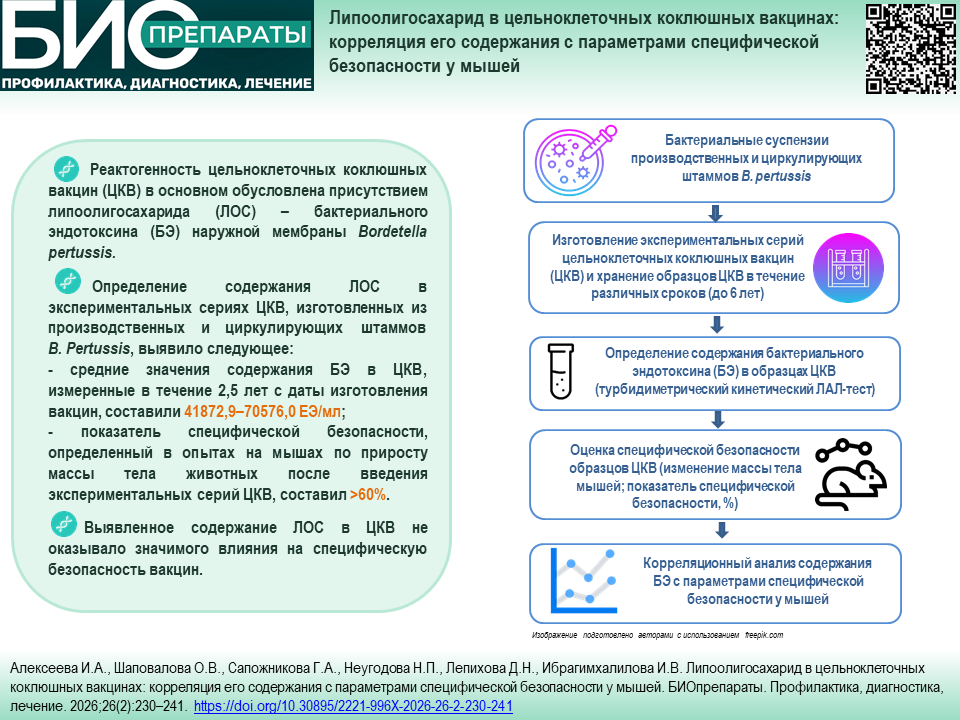
ВВЕДЕНИЕ. Реактогенность цельноклеточных коклюшных вакцин (ЦКВ) в основном обусловлена присутствием липоолигосахарида (ЛОС) — бактериального эндотоксина (БЭ) наружной мембраны Bordetella pertussis. Оценка содержания ЛОС в ЦКВ и его корреляции со специфической безопасностью позволит определить приемлемый уровень ЛОС, не усиливающий реактогенность.
ЦЕЛЬ. Определение содержания липоолигосахарида в цельноклеточных коклюшных вакцинах и установление корреляции с параметрами специфической безопасности у мышей (изменением массы тела и показателем специфической безопасности).
МАТЕРИАЛЫ И МЕТОДЫ. Исследовали экспериментальные серии ЦКВ из производственных (38, 475, 703) и циркулирующих штаммов B. рertussis (1-20, 2-20, 16-16, 25-16, 28(1)-18, 30-18, 33-18), выделенных от больных коклюшем детей. Содержание БЭ определяли гель-тромб тестом и турбидиметрическим методом. Параметры специфической безопасности оценивали через 24 ч и 7 сут после введения препарата по изменению массы тела аутбредных мышей обоего пола, а также по значению показателя специфической безопасности (%).
РЕЗУЛЬТАТЫ. Определено содержание БЭ на протяжении следующих сроков хранения: 1 год после изготовления ЦКВ (до сведения ЦКВ с другими компонентами АКДС-вакцины); от 1 до 2,5 года (срок годности ЦКВ в составе АКДС-вакцины); от 2,5 до 6 лет (после истечения срока годности). Средние значения содержания БЭ в ЦКВ из циркулирующих штаммов при хранении 1 год и 1–2,5 года составили 41872,9–70576,0 ЕЭ/мл; в ЦКВ из производственного штамма при хранении 1–2,5 года — 43980,6 ЕЭ/мл. В вакцинах с продолжительностью хранения 2,5–6 лет средние значения БЭ составляли 1353,8–26655,0 ЕЭ/мл. Установлен широкий диапазон значений содержания БЭ в изготовленных сериях: от <1000–1270 ЕЭ/мл (штамм 30-18) до 36430–94270 ЕЭ/мл (штамм 703). Показатели специфической безопасности образцов, кроме свежеизготовленных 16-16 и 33-18, составили >60%. Установлена обратная корреляционная связь умеренной силы между содержанием БЭ и изменением массы тела мышей и показателем специфической безопасности.
ВЫВОДЫ. Содержание БЭ в образцах ЦКВ с продолжительностью хранения 1 год и 1–2,5 года статистически не различалось. Показатели специфической безопасности образцов (>60%) свидетельствуют о соответствии уровня БЭ требованиям безопасности. Обратная корреляция между содержанием БЭ (in vitro) и показателем специфической безопасности (in vivo) подтверждает роль ЛОС в специфической токсичности препарата, что обосновывает актуальность дальнейшего изучения его уровня в штаммах B. pertussis и влияния на безопасность ЦКВ.
Алексеева И.А., Шаповалова О.В., Сапожникова Г.А., Неугодова Н.П., Лепихова Д.Н., Ибрагимхалилова И.В. Липоолигосахарид в цельноклеточных коклюшных вакцинах: корреляция его содержания с параметрами специфической безопасности у мышей. БИОпрепараты. Профилактика, диагностика, лечение. 2026;26(2):230-240. https://doi.org/10.30895/2221-996X-2026-26-2-230-240
Alekseeva I.A., Shapovalova O.V., Sapozhnikova G.A., Neugodova N.P., Lepikhova D.N., Ibragimkhalilova I.V. Lipooligosaccharide in whole-cell pertussis vaccines: Correlation of its content with specific safety parameters in mice. Biological Products. Prevention, Diagnosis, Treatment. 2026;26(2):230-240. (In Russ.) https://doi.org/10.30895/2221-996X-2026-26-2-230-240
Коклюш, высококонтагиозная инфекция верхних дыхательных путей, вызываемая Bordetella pertussis, остается одной из основных причин детской заболеваемости [1][2]. Летальность от коклюша у новорожденных составляет от 1 до 3%, что обусловливает высокую значимость заболевания для практического здравоохранения [3–5].
Для защиты от коклюшной инфекции применяют цельноклеточную коклюшную вакцину (ЦКВ), которая за время использования зарекомендовала себя как высокоэффективный препарат. Однако местные и системные нежелательные явления, регистрируемые после иммунизации ЦКВ (боль, отек, покраснение места введения препарата, повышение температуры тела) [6], послужили поводом для ограничения ее широкого использования в развитых странах (США, Япония, Великобритания, Германия и др.). Один из важнейших факторов реактогенности ЦКВ — липоолигосахарид (ЛОС) — бактериальный эндотоксин (БЭ) наружной мембраны B. pertussis, обусловливающий эндотоксическую активность, аналогичную таковой у энтеробактерий [7][8]. Помимо этого, ЛОС проявляет адъювантные свойства и участвует в патогенезе коклюшной инфекции, стимулируя иммунный ответ на антигены вакцины. Таким образом, ЛОС влияет как на протекание поствакцинального периода, так и на формирование иммунитета [9]. Поэтому актуальны исследования по определению безопасного диапазона содержания ЛОС в ЦКВ, не повышающего реактогенность, но сохраняющего иммуномодулирующие свойства.
В настоящее время имеются единичные публикации по оценке содержания ЛОС в зарубежных АКДС-вакцинах с цельноклеточным коклюшным компонентом [10]. В Российской Федерации проведено исследование содержания БЭ в препаратах ЛОС, полученных из бактериальной массы B. pertussis и из супернатанта культуральной среды [11]. Данные об уровне БЭ в отдельных штаммах B. рertussis, в том числе вакцинных, отсутствуют. В связи с этим представляло интерес проведение исследования по определению содержания БЭ в ЦКВ, изготовленных из разных штаммов, и установлению связи между уровнем БЭ и основным показателем качества вакцин — специфической безопасностью.
Цель работы — определение содержания липоолигосахарида в цельноклеточных коклюшных вакцинах и установление корреляции с параметрами специфической безопасности у мышей (изменением массы тела и показателем специфической безопасности).
Для выполнения цели были поставлены следующие задачи: выбор метода определения БЭ, отработка условий проведения испытания по определению БЭ, изготовление экспериментальных серий ЦКВ из штаммов B. pertussis, оптимизация процедуры подготовки образцов ЦКВ и определение в них содержания БЭ.
Штаммы. Использованы производственные штаммы B. pertussis 38, 475, 703 и изоляты циркулирующих штаммов 1-20, 2-20, 16-16, 25-16, 28(1)-18, 30-18, 33-18, выделенные от детей, больных коклюшем. Штаммы получены из Государственной коллекции патогенных микроорганизмов ФГБУ «Научный центр экспертизы средств медицинского применения» Минздрава России (ФГБУ «НЦЭСМП» Минздрава России). Из каждого штамма согласно регламенту производства коклюшной вакцины № 136-69 были изготовлены экспериментальные серии ЦКВ (испытуемые образцы). Бактериальную культуру подвергали воздействию формальдегида, после чего в смыв культуры вносили консервант тиомерсал.
Экспериментальные животные. Работа выполнена на аутбредных мышах (самцы, самки; возраст 3,5–4 нед.) массой 15±1 г, полученных из филиала «Андреевка» ФГБУН «Научный центр биомедицинских технологий ФМБА России». Мышей содержали в стандартных условиях вивария со свободным доступом к воде и корму; ежедневно контролировали их состояние. Эвтаназию животных проводили с использованием специальной камеры с углекислым газом. Исследования на животных выполняли в соответствии с нормативными требованиями1. Проведение исследования было одобрено на заседании локального этического комитета ФГБУ «НЦЭСМП» Минздрава России (протокол заседания № 14 от 20.10.2025).
Определение бактериального эндотоксина в испытуемых образцах. Для выбора метода определения БЭ использовали наборы с ЛАЛ/ТАЛ-реактивом и контрольным стандартом эндотоксина (КСЭ): лизат амебоцитов мечехвоста Limulus polyphemus (ЛАЛ-реактив «PYROSTAR ES-F», Wako Chemicals USA, США, кат. № WPEК4-50025, WPEК4-5003, WPEРК4-20015) и лизат амебоцитов мечехвоста Tachypleus tridentatus (ТАЛ-реактив, BioEndo Technology, Китай, кат. № KT0828S). Для разведения образцов использовали воду для теста по определению БЭ (БЭТ) (ООО «Альгимед Техно», Россия, кат. № ALW-50). Все реактивы соответствовали требованиям ОФС.1.2.4.0006.152, не содержали БЭ и не влияли на реакцию лизата амебоцитов (подтверждено сертификатами). В работе использовали термоблок DB-2A/FDB02AD (Bibby Scientific, Великобритания) и фотоколориметр BioТek ELх800 (BioТек Instruments, США).
Несмотря на отсутствие регламентации показателя «Бактериальные эндотоксины» и норм содержания БЭ для вакцин данного типа, на основе анализа литературы установлена теоретическая норма предельного содержания БЭ в ЦКВ — менее 200000 ЕЭ/мл [10]. Это значение учитывали при проведении испытаний.
Сравнивали два метода определения БЭ: гель-тромб и кинетический турбидиметрический метод. В гель-тромб методе готовили ряд разведений испытуемых образцов в воде для БЭТ, добавляли ЛАЛ-реактив (чувствительность 0,25 и 0,03 ЕЭ/мл), инкубировали при температуре 37 °С. В кинетическом турбидиметрическом методе оценивали значения по калибровочной кривой. Критерии приемлемости для калибровочной кривой КСЭ были соблюдены: значения коэффициента корреляции в диапазоне 0,988–1,000 (при норме ≥0,980). Использовали следующий диапазон концентраций КСЭ (для ЛАЛ- и ТАЛ-реактива): 0,1, 1,0, 10, 100 ЕЭ/мл.
Для достижения высокой степени извлечения БЭ из испытуемых образцов рассматривали следующие методы пробоподготовки (на примере серии 33-18): 1) активное перемешивание на вихревой мешалке в течение 15–30 с; 2) нагревание исходных растворов до 80 °С в течение 15 мин; 3) обработка в ультразвуковой бане при температуре 50 °С в течение 15 мин; 4) использование раствора диспергирующего агента Pyrosperse (Lonza, США, кат. № 11620301) в первом разведении (1:10) вместо воды для БЭТ.
Всего было выполнено 46 определений содержания БЭ в образцах ЦКВ. Каждый испытуемый образец исследовали 3–5 раз с интервалом 1–3 мес. В зависимости от продолжительности хранения образцов результаты разделены на 3 группы: группа 1 — определение БЭ в интервале от даты изготовления образца ЦКВ до 1 года хранения (срок годности ЦКВ как полуфабриката до сведения с другими компонентами АКДС-вакцины); группа 2 — определение БЭ в интервале от 1 до 2,5 года после изготовления ЦКВ (период от окончания срока годности полуфабриката до окончания срока годности в составе АКДС-вакцины — 1,5 года); группа 3 — определение БЭ после истечения срока годности АКДС-вакцины (от 2,5 до 6 лет).
Определение специфической безопасности. Специфическую безопасность изготовленных серий ЦКВ определяли в тесте изменения массы тела мышей по методике согласно документу ВОЗ3, подробно изложенной в МУК 4.2.2317-084. Согласно методике, взвешивание проводили до введения препарата, через 72 ч и 7 сут, рассчитывая показатель специфической безопасности как отношение прироста массы тела мышей, которым ввели ЦКВ, к приросту массы тела контрольных животных (требования к величине показателя — не менее 60%). В документе ВОЗ5 допускаются изменения в методике на национальном уровне. Так, в Бразилии [12] измерения массы тела мышей проводят не только через 72 ч и 7 сут, но и через 16–24 ч; изменение массы тела через 16–24 ч отражает присутствие в ЦКВ ЛОС, а через 7 сут — наличие необезвреженного коклюшного токсина. В настоящем исследовании взвешивание животных проводили до введения препарата, через 24 ч и 7 сут, выражая изменение массы тела в граммах и процентах.
Проводили рандомизацию мышей по весу и формировали опытную и контрольную группы по 10 животных. Опытным мышам внутрибрюшинно вводили 0,5 мл испытуемого образца (20 млрд/мл инактивированных бактериальных клеток), контрольным — 0,5 мл физиологического раствора, содержащего тиомерсал в той же концентрации как в испытуемых образцах (по регламенту производства коклюшной вакцины № 136-69). Всего проведено 23 испытания по определению показателя специфической безопасности в образцах.
Статистическая обработка данных. Содер-жание БЭ в испытуемых образцах представлено как среднее арифметическое и его стандартное отклонение. Взаимосвязь между содержанием БЭ в образцах ЦКВ, изменением массы тела мышей и показателем специфической безопасности оценивали по коэффициенту ранговой корреляции Спирмена6. Значения коэффициента интерпретировали следующим образом: менее 0,3 — слабая теснота связи; 0,3–0,7 — умеренная теснота связи; 0,7 и более — высокая теснота связи.
Выбор метода определения. Основным количественным измерениям предшествовал выбор метода определения БЭ. Проведено сравнительное испытание двух методов (гель-тромб и турбидиметрический кинетический) с использованием испытуемого образца ЦКВ 33-18. Установлено, что применение ЛАЛ/ТАЛ-реактивов более высокой чувствительности позволило определять содержание БЭ наиболее корректно (табл. S1 опубликована на сайте журнала в Приложении 17). Результаты испытаний с реактивами чувствительностью 0,03 и 0,1 ЕЭ/мл укладывались в диапазон допустимой погрешности метода.
Для дальнейшей работы выбран турбидиметрический кинетический метод благодаря возможности количественного определения БЭ, тестирования большого количества образцов, а также использованию относительно невысоких разведений испытуемых образцов при построении калибровочной кривой с диапазоном концентраций КСЭ 0,1–100 ЕЭ/мл.
Опытным путем установлено рабочее разведение 1:10000, позволяющее обнаруживать БЭ в образцах.
Пробоподготовка образцов вакцины. Для максимального извлечения БЭ из образцов предварительно подобраны оптимальные условия (табл. S2, Приложение 1). Сравнение различных методов пробоподготовки на примере образца 33-18 показало, что использование ультразвуковой бани нецелесообразно из-за снижения выявления БЭ, а применение диспергирующего агента Pyrosperse в первом разведении 1:10, вероятно, способствует извлечению БЭ из бактериальной клетки. Учитывая незначительные различия между результатами, полученными после перемешивания и перемешивания с нагреванием образцов, для рутинных измерений было выбрано только перемешивание.
Таким образом, были установлены оптимальные условия для определения БЭ в испытуемых образцах ЦКВ: турбидиметрический кинетический метод, разведение 1:10000, перемешивание на вихревой мешалке в течение 15–30 с перед отбором аликвоты. Допустимо использование диспергирующего агента.
Определение содержания бактериального эндотоксина в образцах вакцин при различной продолжительности хранения. Содержание БЭ определяли в испытуемых образцах, изготовленных из производственных и циркулирующих штаммов B. pertussis, с различной продолжительностью хранения этих образцов (табл. 1). Полученные результаты разделены на 3 группы: группа 1 — данные для двух образцов, изготовленных из циркулирующих штаммов 16-16 и 33-18; группа 2 — данные для образцов, изготовленных из производственного штамма 703 и циркулирующих 1-20 и 2-20; группа 3 — данные для образцов, изготовленных из производственных штаммов 38 и 475 и циркулирующих штаммов 25-16, 28(1)-18, 30-18.
Таблица 1. Содержание бактериального эндотоксина (БЭ) в образцах цельноклеточных коклюшных вакцин (ЦКВ), изготовленных из производственных и циркулирующих штаммов, при различной продолжительности хранения вакцин
Table 1. Bacterial endotoxin (BE) content in whole-cell pertussis vaccines (wPV) prepared from production and circulating strains at different storage durations
Штамм B. pertussis Strain B. pertussis | Содержание БЭ при различной продолжительности хранения ЦКВ, ЕЭ/мл Content of BE in wPV at different storage durations, EU/mL |
Продолжительность хранения вакцины: до 1 года Vaccine storage duration: up to 1 year | |
16-16 (n=3) | 41883,3±3687,2 |
33-18 (n=8) | 41872,9±6377,4 |
Продолжительность хранения вакцины: от 1 до 2,5 года Vaccine storage duration: from 1 to 2.5 years | |
703 (n=5) | 43980,6±29391,4 |
1-20 (n=6) | 70576,0±22332,9 |
2-20 (n=6) | 46531,7±18412,8 |
Продолжительность хранения вакцины: от 2,5 до 6 лет Vaccine storage duration: from 2.5 to 6 years | |
38 (n=4) | 6595,3±1840,6 |
475 (n=4) | 26655,0±8367,7 |
25-16 (n=4) | 2361,8±239,4 |
28(1)-18 (n=2) | 5120,5±379,4 |
30-18 (n=4) | 1353,8±286,5 |
Таблица составлена авторами по собственным данным / The table was prepared by the authors using their own data
Показано, что в группах 1 и 2 средние значения содержания ЛОС в образцах ЦКВ 16-16, 33-18, 703 и 2-20 практически одинаковы: уровень ЛОС в ЦКВ из циркулирующих штаммов соответствует таковому в производственном штамме 703. Исключение составила вакцина, изготовленная из циркулирующего штамма 1-20, с несколько более высоким содержанием БЭ. В группе 3 зафиксировано значительное снижение содержания БЭ в испытуемых образцах. При этом вакцина из производственного штамма 475 сохранила уровень эндотоксина, близкий к значениям в первых двух группах, тогда как образцы из производственного штамма 38 и циркулирующих штаммов 25-16, 28(1)-18 и 30-18 содержали значительно меньше БЭ.
Данные о содержании БЭ в испытуемых образцах ЦКВ и изменении массы тела мышей после внутрибрюшинного введения этих же вакцин представлены в таблице 2. Также приведены данные определения показателя специфической безопасности для тех опытов, которые выполнены одновременно с оценкой БЭ или с интервалом не более недели. БЭ определяли in vitro, специфическую безопасность — in vivo с использованием тех же образцов. Таким образом, каждому измерению БЭ в ЦКВ соответствовал опыт на мышах с введением той же серии вакцины, в котором определяли изменение массы тела (г, %) через 24 ч и 7 сут, а также показатель специфической безопасности.
Таблица 2. Содержание бактериального эндотоксина (БЭ) в образцах цельноклеточных коклюшных вакцин (ЦКВ), изменение массы тела мышей после введения вакцин и показатель специфической безопасности
Table 2. Bacterial endotoxin (BE) content in samples of whole-cell pertussis vaccines (wPV), body weight change in mice after their administration, and specific safety index
Штамм B. pertussis для изготовления ЦКВ Strain of B. pertussis used for wPV manufacturing | Содержание БЭ, ЕЭ/мл BE content, EU/mL | Изменение массы тела мышей, г / % Change in body weight of mice, g / % | Показатель специфической безопасности, % Specific safety index, % | |
На 1 сут On Day 1 | На 7 сут On Day 7 | |||
38 | 8163 | 0,21/1,43 | 8,0/54,30 | 109,3 |
3893 | 0,46/3,1 | 9,22/62,20 | 111,1 | |
475 | 21170 | 0,43/2,92 | 6,74/45,73 | 103,9 |
703 | 38100 | 0,11/0,73 | 6,34/41,82 | 85,2 |
36430 | –0,18/–1,18 | 5,97/39,59 | 99,6 | |
94270 | –0,77/–5,19 | 5,77/38,91 | 94,4 | |
16-16 | 29150 | –1,52/–9,91 | 1,16/7,56 | 15,8 |
48540 | –0,66/–4,25 | 1,83/12,11 | 28,1 | |
47960 | –0,79/–5,37 | 3,27/22,35 | 51,45 | |
25-16 | 2486 | –0,11/–0,74 | 8,90/59,97 | 119,6 |
2015 | –0,16/–1,06 | 6,0/39,58 | 112,4 | |
28(1)-18 | 4584 | 0,09/0,62 | 6,84/46,79 | 105,4 |
33-18 | 29820 | –0,60/–3,96 | 3,72/24,57 | 50,0 |
37780 | 0,21/1,37 | 3,49/22,84 | 55,0 | |
25040 | –0,93/–6,24 | 2,62/17,57 | 42,9 | |
1-20 | 67480 | –0,95/–6,15 | 6,35/41,10 | 75,3 |
38420 | –0,19/–1,26 | 8,17/54,0 | 109,8 | |
35480 | –1,17/–7,72 | 5,20/33,74 | 97,4 | |
2-20 | 29810 | –0,20/–1,36 | 7,66/52,07 | 103,0 |
23420 | –0,25/–1,64 | 5,26/34,54 | 98,5 | |
27700 | –0,02/–0,14 | 7,38/50,0 | 113,7 | |
30-18 | <1000 | 0,10/0,68 | 8,20/55,30 | 102,5 |
<1270 | –0,37/–2,43 | 7,07/46,50 | 96,6 | |
Таблица составлена авторами по собственным данным / The table was prepared by the authors using their own data
Показатели специфической безопасности в экспериментальных сериях ЦКВ (за исключением образцов 16-16 и 33-18) значительно превышали 60%, что свидетельствует об их соответствии требованиям ВОЗ8 и МУК 4.2.2317-089. Значения показателя специфической безопасности в образцах 16-16 и 33-18 были ниже 60%, что, вероятно, связано с использованием недавно изготовленных образцов, в которых процесс детоксикации еще не завершился.
Прирост массы тела мышей на 7 сут после введения препарата соответствовал значениям, получаемым при оценке качества коммерческих вакцин надлежащего качества. Изменение массы тела мышей через 24 ч ранее при экспертизе коммерческих серий АКДС-вакцины не оценивали, поэтому для объективного анализа полученных результатов требуются дальнейшие наблюдения.
Для оценки влияния ЛОС в образцах на параметры специфической безопасности проведен корреляционный анализ, который выявил статистически значимые обратные корреляции умеренной силы между содержанием БЭ в исследуемых сериях вакцин и всеми параметрами специфической безопасности (табл. 3). На 7 сут связь с изменением массы тела (rs ≈ –0,50, p<0,05) была несколько сильнее, чем на 1 сут (rs ≈ –0,45, p<0,05). Наиболее сильная обратная корреляция наблюдалась между содержанием БЭ и показателем специфической безопасности (rs = –0,535, p<0,01). Полученные данные свидетельствуют о том, что ЛОС, входящий в состав клеток B. pertussis, вносит прямой вклад в токсическое действие, регистрируемое при оценке специфической безопасности ЦКВ, и значимость его уровня как фактора, определяющего тяжесть реакции организма на введение вакцины.
Таблица 3. Корреляция между содержанием бактериального эндотоксина (БЭ) и параметрами специфической безопасности у мышей (изменение массы тела и показатель специфической безопасности)
Table 3. Correlation between bacterial endotoxin (BE) content and specific safety parameters in mice (body weight change and specific safety index)
Параметр Parameter | Коэффициент ранговой корреляции Спирмена, rs Spearman's rank correlation coefficient, rs |
Изменение массы тела через 24 ч: Body weight change after 24 hours: граммы / grams % | –0,451* –0,445* |
Изменение массы тела через 7 сут: Body weight change after 7 days: граммы / grams % | –0,502* –0,501* |
Показатель специфической безопасности, % Specific safety index, % | –0,535** |
Таблица составлена авторами по собственным данным / The table was prepared by the authors using their own data
Примечание. * p<0,05; ** p<0,01.
Note. * p<0.05; ** p<0.01.
При сопоставлении наших результатов с литературными данными установлено, что содержание БЭ в исследованных образцах ЦКВ в целом укладывается в диапазон, характерный для зарубежных коммерческих АКДС-вакцин с цельноклеточным коклюшным компонентом (7600–181640 ЕЭ/мл) [10]. Так, содержание БЭ в образце ЦКВ из производственного штамма 703 при хранении 1–2,5 года составило 43980,6±29391,4 ЕЭ/мл; уровень БЭ для образцов ЦКВ из циркулирующих штаммов (16-16, 33-18, 1-20, 2-20) в тот же период также находился в указанном диапазоне (табл. 1). Значительный разброс значений БЭ как в нашем исследовании, так и в случае коммерческих вакцин, по-видимому, обусловлен использованием различных штаммов B. pertussis, технологических подходов производства и количеством бактериальных клеток в дозе вакцины. Следует отметить, что приведенные диапазоны БЭ отражают результаты многолетнего анализа вакцин. Рекомендованный уровень БЭ для вакцинных препаратов, содержащих анатоксины, составляет менее 200000 ЕЭ/мл, что обусловлено сложным составом таких вакцин и их получением из бактериальных клеток с минимальной степенью очистки. Для сравнения, в БКВ, состоящих из стандартизованного набора отдельных антигенов, уровень БЭ составляет 0,288–1390,8 ЕЭ/мл [10].
В исследованных образцах ЦКВ, находившихся на хранении более 2,5 года, за исключением штаммов 475 и 38, выявлен значительно более низкий уровень БЭ. Возможно, это связано с длительным хранением, которое могло повлиять на структурную целостность антигенов.
Несмотря на различия в уровнях БЭ в образцах ЦКВ, его выявленное содержание не оказывало значимого влияния на специфическую безопасность вакцин. Как следует из таблицы 2, показатель специфической безопасности для всех исследованных образцов, кроме свежеизготовленных 16-16 и 33-18, превышал 60%. В этих двух образцах процесс детоксикации, по-видимому, еще не завершился, чем и объясняются значения ниже нормы (<60%). Важно отметить, что содержание БЭ в образцах 16-16 и 33-18 было сопоставимо с его уровнем в образцах со сроком хранения 1–2,5 года, имевших нормальный показатель безопасности (>60%). Это позволяет предположить, что низкие значения показателя безопасности обусловлены не присутствием ЛОС, а действием других токсинов, в частности коклюшного токсина. Кроме того, бактериальная клетка B. pertussis содержит около 3000 различных белков, которые также могут вносить вклад в реактогенность препарата [13].
Учитывая, что ЛОС является одним из факторов, влияющих на реактогенность, в настоящем исследовании оценена корреляция между параметрами специфической безопасности и содержанием данного токсина в образце ЦКВ. Полученные данные (табл. 3) свидетельствуют о том, что ЛОС вносит прямой вклад в токсическое действие, регистрируемое при оценке параметров специфической безопасности ЦКВ, и его уровень является значимым фактором, определяющим тяжесть реакции организма мышей на введение вакцины.
Таким образом, в результате проведенной работы установлено содержание ЛОС в составе производственных и циркулирующих штаммов B. pertussis и показана его корреляционная связь со специфической безопасностью. Высокие значения показателя специфической безопасности образцов ЦКВ отражают их незначительную реактогенность, то есть присутствующее количество ЛОС не оказывает значимого влияния на безопасность. Данное исследование выполнено на экспериментальных сериях ЦКВ, изготовленных из отдельных штаммов. В дальнейшем планируется определить содержание ЛОС в коммерческих сериях АКДС-вакцины.
Согласно данным литературы ЛОС считается одним из основных компонентов, ответственных за реактогенность ЦКВ [12][14][15]. Действуя как изолированно, так и синергично с другими токсинами B. pertussis (коклюшный токсин, аденилатциклаза), ЛОС может вызывать серьезные нежелательные явления у реципиентов АКДС-вакцины [13]. Эндотоксический эффект ЛОС препятствует его включению в состав БКВ [16]. Реактогенность вакцин, проявляющаяся нежелательными явлениями, приводит к утрате доверия у населения к вакцинации, что может иметь долгосрочные негативные последствия. Поэтому продолжается поиск путей создания высококачественных вакцин. Идеальная вакцина должна быть нереактогенной, простой в применении и высокоиммуногенной, обеспечивая длительный иммунитет [13].
Один из подходов к снижению реактогенности — снижение содержания ЛОС в вакцине. Имеются данные о том, что химическая экстракция ЛОС приводит к значительному снижению его уровня (до 20%) и уменьшению токсичности без влияния на эффективность и стабильность АКДС-вакцины [12]. Эндотоксическая активность в такой вакцине составляла 1,54×10⁴ против 0,53×10⁶ МЕ/мг в коммерческом препарате [12].
В последние десятилетия для снижения эндотоксичности ЦКВ активно применяются методы генной инженерии [14][17–21]. Так, экспрессия генетически модифицированного фермента PagP B. pertussis приводила к повышению эндотоксической активности ЛОС, а фермента PagL — к снижению активности ЛОС [17]. ЛОС из штаммов, экспрессирующих PagP, обладал более высокой способностью стимулировать продукцию IL-6 макрофагами, тогда как клетки с PagL продуцировали на 21% меньше ЛОС и проявляли сниженную стимулирующую активность по сравнению с контрольным штаммом [17].
Помимо эндотоксичности, ЛОС обладает мощной адъювантной активностью, что делает его важным компонентом ЦКВ [17]. ЛОС является наиболее широко представленной структурой на клеточной поверхности B. рertussis, играющей важную роль во взаимодействиях хозяина и патогена [22]. Действуя синергически с трахеальным цитотоксином и коклюшным токсином, ЛОС участвует в индукции синтазы оксида азота в эпителиальных клетках дыхательных путей с последующей выработкой активных форм кислорода, таких как окись азота (NO), и повреждением реснитчатых клеток слизистой оболочки дыхательных путей [23][24].
Кроме участия в патогенезе, ЛОС проявляет свойства защитного антигена [25]. Антитела к ЛОС обладают комплемент-зависимой бактерицидной активностью [26][27] и существенно снижают колонизацию дыхательных путей мышей после аэрозольной инфекции [28]. Олигосахаридный сегмент ЛОС, не обладающий активностью эндотоксина, содержит эпитопы для бактерицидных антител [26][29][30], что делает его перспективным антигеном для включения в состав БКВ. Однако олигосахариды неиммуногенны, поэтому для преодоления этого проводят их конъюгирование с иммуногенным носителем, синтезируя гликоконъюгаты [16][27][31]. В случае B. pertussis важно, что олигосахаридный компонент эволюционно стабилен и практически неизменен у клинических изолятов на протяжении многих лет [31], то есть не подвержен антигенному дрейфу [16]. Липидная часть ЛОС также консервативна, что указывает на ее жизненную важность для бактерии. ЛОС активирует клетки врожденного иммунитета, способствуя активации адаптивного ответа и индукции выработки бактерицидных антител [31][32]. Это позволяет рассматривать ЛОС как необходимый компонент коклюшных вакцин.
В настоящее время не определено минимальное количество ЛОС, обеспечивающее защитную активность, безопасность и стабильность вакцины. Учитывая пирогенность и токсичность эндотоксинов, актуальны дальнейшие исследования по оценке их содержания как в исходном материале, так и в полуфабрикатах и готовых коклюшных вакцинах.
Дополнительная информация. На сайте журнала «БИОпрепараты. Профилактика, диагностика, лечение» опубликовано Приложение 1.
https://doi.org/10.30895/2221-996X-2026-26-2-230-240-annex
Вклад авторов. Все авторы подтверждают соответствие своего авторства критериям ICMJE. Наибольший вклад распределен следующим образом: И.А. Алексеева — формулирование цели работы, анализ и систематизация данных научной литературы, анализ и интерпретация результатов исследования, написание и редактирование текста рукописи; О.В. Шаповалова — проведение экспериментов, анализ и интерпретация результатов исследования; редактирование текста рукописи; Н.П. Неугодова — планирование исследования, анализ и интерпретация результатов исследования, редактирование текста рукописи; Д.Н. Лепихова — проведение экспериментов, сбор и анализ данных научной литературы, редактирование текста рукописи; Г.А. Сапожникова и И.В. Ибрагимхалилова — проведение экспериментов, сбор и анализ данных научной литературы, работа с иллюстративным материалом.
Соответствие принципам этики. Проведение исследования было одобрено на заседании локального этического комитета ФГБУ «НЦЭСМП» Минздрава России (протокол заседания № 14 от 20.10.2025).
Использование генеративного искусственного интеллекта. Авторы заявляют, что не использовали генеративный ИИ при подготовке рукописи.
Supplementary information. Supplementary material 1 is available on the website of Biological Products. Prevention, Diagnosis, Treatment.
https://doi.org/10.30895/2221-996X-2026-26-2-230-240-annex
Author contributions. All authors confirm that they meet the ICMJE criteria for authorship. The most significant contributions were as follows. I.A. Alekseeva conceptualized the study, analyzed and systematized the scientific literature data, analyzed and interpreted the data, and drafted and edited the manuscript. O.V. Shapovalova conducted experiments, analyzed and interpreted the data, and edited the manuscript. N.P. Neugodova designed the study, analyzed and interpreted the data, and edited the manuscript. D.N. Lepikhova conducted experiments, collected and analyzed the scientific literature data, and edited the manuscript. G.A. Sapozhnikova and I.V. Ibragimkhalilova conducted experiments, collected and analyzed the scientific literature data, and prepared the graphical materials.
Ethics approval. The study was approved by the Local Ethics Committee at the Scientific Centre for Expert Evaluation of Medicinal Products (meeting minutes No. 14 dated October 20, 2025).
Use of generative artificial intelligence. The authors declare that no generative AI was used during the preparation of this manuscript.
1. Directive 2010/63/EU of the European Parliament and of the Council of 22 September 2010 on the protection of animals used for scientific purposes; European Parliament and Council; 2010.
European Convention for the protection of vertebrate animals used for experimental and other scientific purposes. Council of Europe; 1986.
ГОСТ 33216-2014 Руководство по содержанию и уходу за лабораторными животными. Правила содержания и ухода за лабораторными грызунами и кроликами.
Решение ЕЭК от 03.11.2016 № 81 «Об утверждении Правил надлежащей лабораторной практики Евразийского экономического союза в сфере обращения лекарственных средств».
Рекомендации Коллегии ЕЭК от 14.11.2023 № 33 «О Руководстве по работе с лабораторными (экспериментальными) животными при проведении доклинических (неклинических) исследований».
2. ОФС. 1.2.4.0006.15 Бактериальные эндотоксины. Государственная фармакопея Российской Федерации. XIV изд. М.; 2018.
3. Recommendations for whole-cell pertussis vaccine, Annex 6, Technical report series No. 941. WHO; 2007.
4. МУК 4.2.2317-08 «Отбор, проверка и хранение производственных штаммов коклюшных, паракоклюшных и бронхисептикозных бактерий». М.: Федеральный центр гигиены и эпидемиологии Роспотребнадзора; 2009.
5. Recommendations for whole-cell pertussis vaccine, Annex 6, Technical report series No. 941. WHO; 2007.
6. Коэффициент ранговой корреляции Спирмена. http://www.psychol-ok.ru/statistics/spearman/
7. https://doi.org/10.30895/2221-996X-2026-26-2-230-240-annex
8. Recommendations for whole-cell pertussis vaccine, Annex 6, Technical report series No. 941. WHO; 2007.
9. МУК 4.2.2317-08 «Отбор, проверка и хранение производственных штаммов коклюшных, паракоклюшных и бронхисептикозных бактерий». М.: Федеральный центр гигиены и эпидемиологии Роспотребнадзора; 2009.
1. Gendrel D, Raymond J. Pertussis worldwide. Vaccinating children and adults. Med Trop Sante Int. 2023;3(4): mtsi.v3i4.2023.446 (In French). https://doi.org/10.48327/mtsi.v3i4.2023.446
2. Liu Y, Yu D, Wang K, Ye Q. Global resurgence of pertussis: A perspective from China. J Infect. 2024;89(5):106289. https://doiorg/10.1016/j.jinf.2024.106289
3. Winter K, Harriman K, Murray E, et al. Risk factors associated with infant death from pertussis: A case-control study. Clin Infect Dis. 2015;61(7):1099–106. https://doi.org/10.1093/cid/civ472
4. Guzman-Holst A, Luna-Casas G, Cervantes-Apolinar MY, et al. Pertussis infant morbidity and mortality trends after universal maternal immunisation in Mexico: An ecological database study with time-series analysis. Vaccine. 2021;39(16):2311–18. https://doi.org/10.1016/j.vaccine.2021.02.038
5. Macina D, Evans KE. Bordetella pertussis in school-age children, adolescent and adults: A systematic review of epidemiology and mortality in Europe. Infect Dis Ther. 2021;10(4):2071–118. https://doi.org/10.1007/s40121-021-00520-9
6. Decker MD, Edwards KM. Pertussis (whooping cough). J Infect Dis. 2021;224(12 Suppl 2):S310-S320. https//doi.org/10.1093/infdis/jiaa469
7. Ayme G, Caroff M, Chaby R, et al. Biological activities of fragments derived from Bordetella pertussis endotoxin: isolation of a nontoxic, Shwartzman-negative lipid A possessing high adjuvant properties. Infect Immun. 1980;27(3): 739–45. https://doi.org/10.1128/iai.27.3.739-745.1980
8. Watanabe M, Takimoto H, Kumazawa Y, Amano K. Biological properties of lipopolysaccharides from Bordetella species. J Gen Microbiol. 1990;136(3):489–93. https://doi.org/10.1099/00221287-136-3-489
9. Алексеева ИА, Перелыгина ОВ, Колышкина ЕД. Коклюшные вакцины и роль липоолигосахарида Bordetella pertussis в иммунном ответе на коклюшную инфекцию и вакцинацию. БИОпрепараты. Профилактика, диагностика, лечение. 2021;21(1):10–9. https://doi.org/10.30895/2221-996X-2021-21-1-10-19
10. Brito LA, Singh M. Acceptable levels of endotoxin in vaccine formulations during preclinical research. J Pharm Sci. 2011;100(1):34–7. https://doi.org/10.1002/jps.22267
11. Nazirov MR, Poddubikov AV, Kukes VG, et al. Quantitative assay of B. pertussis lipopolysaccharide. Bull Exp Biol Med. 2022; 172(6):718–20. https://doi.org/10.1007/s10517-022-05463-w
12. Dias WO, van der Ark AAJ, Sakauchi MA, et al. An improved whole cell pertussis vaccine with reduced content of endotoxin. Hum Vaccin Immunother. 2013;9(2):339–48. https://doi.org/10.4161/hv.22847
13. Moylett EH, Hanson IC. Mechanistic actions of the risks and adverse events associated with vaccine administration. J Allergy Clin Immunol. 2004;114(5):1010–20. https://doi.org/10.1016/j.jaci.2004.09.007
14. Pérez-Ortega J, van Boxtel R, de Jonge EF, Tommassen J. Regulated expression of lpxC allows for reduction of endotoxicity in Bordetella pertussis. Int J Mol Sci. 2022;23(14):8027. https://doi.org/10.3390/ijms23148027
15. Baffeta F, Cecchi R, Guerrini E, et al. Relationship between endotoxin content in vaccine preclinical formulations and animal welfare: An extensive study on historical data to set an informed threshold. Vaccines 2024;12(7):815. https://doi.org/10.3390/vaccines12070815
16. Koj S, Ucieklak K, Lugowski C, Niedziela T. Structure and immunogenicity of the Bordetella pertussis LOS-derived oligosaccharides in the endosomal-like pre-processing mice model. Vaccines (Basel). 2021;9(6):645. https://doi.org/10.3390/vaccines9060645
17. Geurtsen J, Steeghs L, Hamstra HJ, et al. Expression of the lipopolysaccharide-modifying enzymes PagP and PagL modulates the endotoxic activity of Bordetella pertussis. Infect Immun. 2006;74(10):5574–85. https://doi.org/10.1128/IAI.00834-06
18. Arenas J, Pupo E, Phielix C, et al. Shortening the lipid A acyl chains of Bordetella pertussis enables depletion of lipopolysaccharide endotoxic activity. Vaccines (Basel). 2020;8(4):594. https://doi.org/10.3390/vaccines8040594
19. Pérez-Ortega J, van Boxtel R, Plisnier M, et al. Biosynthesis of the inner core of Bordetella pertussis lipopolysaccharides: Effect of mutations on LPS structure, cell division, and Toll-like receptor 4 activation. Int J Mol Sci. 2023;24(24):17313. https://doi.org/10.3390/ijms242417313
20. Skopova K, Holubova J, Bockova B, et al. Less reactogenic whole-cell pertussis vaccine confers protection from Bordetella pertussis infection. mSphere. 2025;10(4):e0063924. https://doi.org/10.1128/msphere.00639-24
21. Mohamed YF, Fernandez RC. Programming Bordetella pertussis lipid A to promote adjuvanticity. Microbial Cell Factories. 2024;23(1):250. https://doi.org/10.1128/s12934-024-02518-7
22. de Gouw D, Diavatopoulos DA, Bootsma HJ, et al. Pertussis: A matter of immune modulation. FEMS Microbiol Rev. 2011;35(3):441–74. https://doi.org/10.1111/j.1574-6976.2010.00257.x
23. Flak TA, Goldman WE. Signalling and cellular specificity of airway nitric oxide production in pertussis. Cell Microbiol. 1999;1(1):51–60. https://doi.org/10.1046/j.1462-5822.1999.00004.x
24. Flak TA, Heiss LN, Engle JT, Goldman WE. Synergistic epithelial responses to endotoxin and a naturally occurring muramyl peptide. Infect Immun. 2000;68(3):1235–42. https://doi.org/10.1128/IAI.68.3.1235-1242.2000
25. Trollfors B, Lagergård T, Taranger J, et al. Serum immunoglobulin G antibody responses to Bordetella pertussis lipooligosaccharide and B. parapertussis lipopolysaccharide in children with pertussis and parapertussis. Clin Diagn Lab Immunol. 2001;8(5):1015–17. https://doi.org/10.1128/CDLI.8.5.1015-1017.2001
26. Belcher T, Dubois V, Rivera-Millot A, et al. Pathogenicity and virulence of Bordetella pertussis and its adaptation to its strictly human host. Virulence. 2021;12(1):2608–32. https://doi.org/10.1080/21505594.2021.1980987
27. Gao J, Huang L, Luo S, et al. A novel vaccine formulation candidate based on lipooligosaccharides and pertussis toxin against Bordetella pertussis. Front Immunol. 2023; 14:1124695. https://doi.org/10.3389/fimmu.2023.1124695
28. Mountzouros KT, Kimura A, Cowell JL. A bactericidal monoclonal antibody specific for the lipooligosaccharide of Bordetella pertussis reduces colonization of the respiratory tract of mice after aerosol infection with B. pertussis. Infect Immun. 1992;60(12):5316–8. https://doi.org/10.1128/iai.60.12.5316-5318.1992
29. Weiss AA, Patton AK, Millen SH, et al. Acellular pertussis vaccines and complement killing of Bordetella pertussis. Infect Immun. 2004;72(12):7346–51. https://doi.org/10.1128/iai.72.12.7346-7351.2004
30. Wang P, Ramadan S, Dubey P, et al. Development of carbohydrate based next-generation anti-pertussis vaccines. Bioorg Med Chem. 2022;15(74):117066. https://doi.org/10.1016/j.bmc.2022.117066
31. Albitar-Nehme S, Basheer SM, Njamkepo E, et al. Comparison of lipopolysaccharide structures of Bordetella pertussis clinical isolates from pre- and post-vaccine era. Carbohydr Res. 2013;378:56–62. https://doi.org/10.1016/j.carres.2013.05.002
32. Steinman RM, Hemmi H. Dendritic cells: Translating innate to adaptive immunity. In: Pulendran B, Ahmed R, eds. From innate immunity to immunological memory. Current topics in microbiology and immunology. Berlin, Heidelberg: Springer; 2006. P. 17–58. https://doi.org/10.1007/3-540-32636-7_2
Алексеева Ирина Андреевна, д-р мед. наук
Петровский б-р, д. 8, стр. 2, Москва, 127051
Шаповалова Ольга Владимировна, канд. фарм. наук
Петровский б-р, д. 8, стр. 2, Москва, 127051
Сапожникова Галина Алексеевна
Петровский б-р, д. 8, стр. 2, Москва, 127051
Неугодова Наталия Петровна, канд. биол. наук
Петровский б-р, д. 8, стр. 2, Москва, 127051
Лепихова Дарья Николаевна
Петровский б-р, д. 8, стр. 2, Москва, 127051
Ибрагимхалилова Ильхамья Вейсаловна, канд. биол. наук
Петровский б-р, д. 8, стр. 2, Москва, 127051

|
1. Приложение 1 | |
| Тема | ||
| Тип | Исследовательские инструменты | |
Скачать
(715KB)
|
Метаданные ▾ | |
Алексеева И.А., Шаповалова О.В., Сапожникова Г.А., Неугодова Н.П., Лепихова Д.Н., Ибрагимхалилова И.В. Липоолигосахарид в цельноклеточных коклюшных вакцинах: корреляция его содержания с параметрами специфической безопасности у мышей. БИОпрепараты. Профилактика, диагностика, лечение. 2026;26(2):230-240. https://doi.org/10.30895/2221-996X-2026-26-2-230-240
Alekseeva I.A., Shapovalova O.V., Sapozhnikova G.A., Neugodova N.P., Lepikhova D.N., Ibragimkhalilova I.V. Lipooligosaccharide in whole-cell pertussis vaccines: Correlation of its content with specific safety parameters in mice. Biological Products. Prevention, Diagnosis, Treatment. 2026;26(2):230-240. (In Russ.) https://doi.org/10.30895/2221-996X-2026-26-2-230-240

 Послать статью по эл. почте (Необходимо имя пользователя (логин))
Связаться с автором (Необходимо имя пользователя (логин))
Послать статью по эл. почте (Необходимо имя пользователя (логин))
Связаться с автором (Необходимо имя пользователя (логин)) Издатель: ФГБУ «НЦЭСМП» Минздрава России





