


Specific activity and toxicity of lyophilized recombinant human granulocyte-macrophage colony-stimulating factor (E. coli BL21/pET-GST6His-GM): in vitro and in vivo study
 S. G. Gamaley,
G. G. Shimina,
E. A. Vyazovaya,
O. V. Simakova,
T. G. Yadrenkina,
O. S. Taranov,
V. V. Omigov,
K. F. Emtsova,
T. I. Esina,
E. A. Volosnikova,
E. D. Danilenko
S. G. Gamaley,
G. G. Shimina,
E. A. Vyazovaya,
O. V. Simakova,
T. G. Yadrenkina,
O. S. Taranov,
V. V. Omigov,
K. F. Emtsova,
T. I. Esina,
E. A. Volosnikova,
E. D. Danilenko https://doi.org/10.30895/2221-996X-2026-26-1-108-118

Abstract
INTRODUCTION. The development of new effective drugs based on granulocyte-macrophage colony-stimulating factor (GM-CSF) remains a relevant objective: the study of the drug’s biological effects opens new prospects for its clinical use in the treatment of a wide range of diseases – from oncological and hematological disorders to neurodegenerative conditions. Developing a new lyophilized recombinant human GM-CSF (rhGM-CSF) based on Esсherichia coli BL21/pET-GST-6His-GM producer strain warrants an assessment of its specific activity and toxicity.
AIM. This study aimed to examine the specific proliferative activity (in vitro) and hematopoietic stimulatory effect (in vivo), as well as acute and subchronic toxicity of a new lyophilized rhGM-CSF preparation for subcutaneous administration.
MATERIALS AND METHODS. Lyophilized rhGM-CSF (strain E. coli BL21/pET-GST-6His-GM) produced by State Research Center of Virology and Biotechnology “Vector” (Russia) was used in the study. The proliferative activity was assessed in the human erythroleukemia TF-1 cell culture by XTT assay. Hematopoietic stimulatory activity was assessed in male CBA/Calac mice subjected to cyclophosphamide-induced myelosuppression (200 mg/kg, intraperitoneally). The rhGM-CSF preparation was administered at a dose of 90 μg/kg subcutaneously daily for 4 days. A leukogram was calculated on Day 5. The acute toxicity of the preparation was assessed by a single subcutaneous administration to male and female ICR mice at 500 and 1,000 μg/kg, subchronic toxicity – by four subcutaneous administrations at 90 μg/kg. On Days 1 and 7, body weight, temperature, complete blood count, biochemical markers and internal organ histology (heart, lungs, liver, kidneys, etc.) were evaluated.
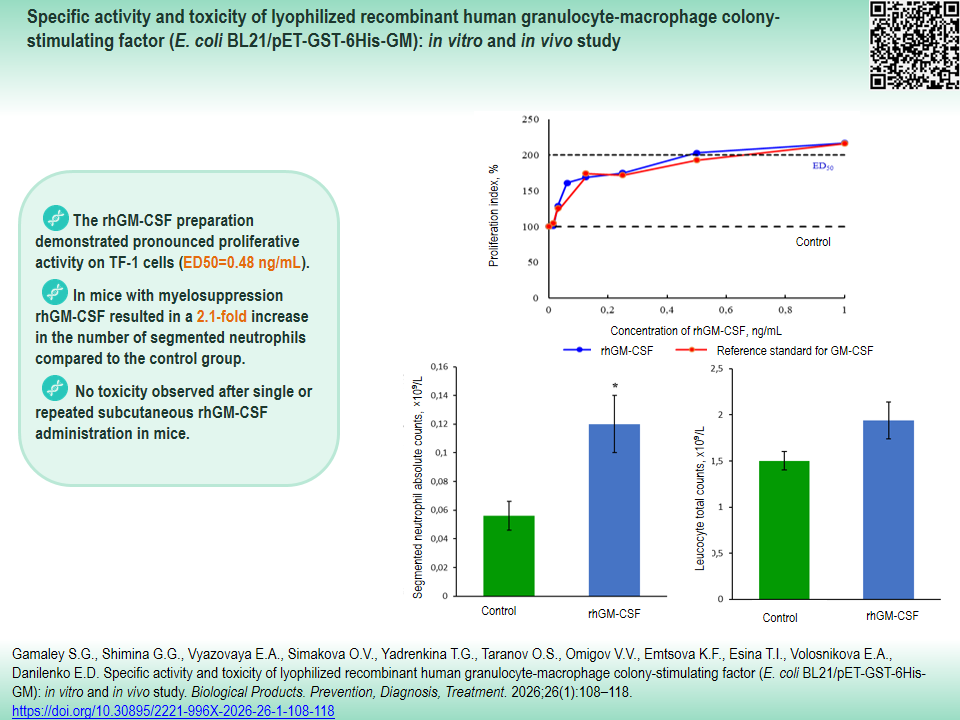
RESULTS. The rhGM-CSF preparation demonstrated pronounced proliferative activity on TF-1 cells (ED50=0.48 ng/mL). In mice with myelosuppression, the preparation resulted in a 2.1-fold increase in the number of segmented neutrophils compared to the control group. Single and repeated administration did not cause death of animals, did not affect body weight or temperature, nor did it result in significant changes of hematological or biochemical parameters or macro- and microscopic anatomy of organs.
CONCLUSIONS. The new lyophilized rhGM-CSF preparation has demonstrated high proliferative and hematopoietic stimulatory activity, as well as insignificant acute and subchronic toxicity. The obtained results substantiate further pharmaceutical development of the preparation as an effective and safe hematopoietic stimulatory agent.
Keywords
granulocyte-macrophage colony-stimulating factor,
recombinant proteins,
rhGM-CSF,
lyophilized preparation,
cell proliferation,
hematopoiesis,
acute toxicity,
subchronic toxicity,
myelosuppression,
in vitro,
in vivo
Funding: The study was funded under State Assignment of the State Research Center of Virology and Biotechnology “Vector” of Rospotrebnadzor for applied scientific research (R&D Registry No. 121040200101-8)
About the Authors
S. G. Gamaley
State Research Center of Virology and Biotechnology “Vector”
Russian Federation
Russian Federation
Svetlana G. Gamaley
Koltsovo, Novosibirsk Region 630559
G. G. Shimina
State Research Center of Virology and Biotechnology “Vector”
Russian Federation
Russian Federation
Galina G. Shimina
Koltsovo, Novosibirsk Region 630559
E. A. Vyazovaya
State Research Center of Virology and Biotechnology “Vector”
Russian Federation
Russian Federation
Elena A. Vyazovaya, Cand. Sci. (Biol.)
Koltsovo, Novosibirsk Region 630559
O. V. Simakova
State Research Center of Virology and Biotechnology “Vector”
Russian Federation
Russian Federation
Olga V. Simakova
Koltsovo, Novosibirsk Region 630559
T. G. Yadrenkina
State Research Center of Virology and Biotechnology “Vector”
Russian Federation
Russian Federation
Tatyana G. Yadrenkina, Cand. Sci. (Vet.)
Koltsovo, Novosibirsk Region 630559
O. S. Taranov
State Research Center of Virology and Biotechnology “Vector”
Russian Federation
Russian Federation
Oleg S. Taranov
Koltsovo, Novosibirsk Region 630559
V. V. Omigov
State Research Center of Virology and Biotechnology “Vector”
Russian Federation
Russian Federation
Vladimir V. Omigov, Cand. Sci. (Med.)
Koltsovo, Novosibirsk Region 630559
K. F. Emtsova
State Research Center of Virology and Biotechnology “Vector”
Russian Federation
Russian Federation
Ksenia F. Emtsova
Koltsovo, Novosibirsk Region 630559
T. I. Esina
State Research Center of Virology and Biotechnology “Vector”
Russian Federation
Russian Federation
Tatyana I. Esina
Koltsovo, Novosibirsk Region 630559
E. A. Volosnikova
State Research Center of Virology and Biotechnology “Vector”
Russian Federation
Russian Federation
Ekaterina A. Volosnikova, Cand. Sci. (Biol.)
Koltsovo, Novosibirsk Region 630559
E. D. Danilenko
State Research Center of Virology and Biotechnology “Vector”
Russian Federation
Russian Federation
Elena D. Danilenko, Cand. Sci. (Biol.)
Koltsovo, Novosibirsk Region 630559
References
1. Zurochka AV, Gritsenko VA, Zurochka VA, et al. Granulocyte-macrophage colony-stimulating factor (GM-CSF) and its synthetic analogues: immunobiological effects and clinical application. Ekaterinburg: UrO RAN; 2021 (In Russ.). EDN: LXCUQE
2. McCarthy J, Boyle N, McCarthy C. Recombinant GM-CSF drug evaluation review. Immunotherapy. 2025;17(14):983–93. https://doi.org/10.1080/1750743X.2025.2571020
3. Petrina M, Martin J, Basta S. Granulocyte macrophage colony-stimulating factor has come of age: From a vaccine adjuvant to antiviral immunotherapy. Cytokine Growth Factor Rev. 2021;59:101–10. https://doi.org/10.1016/j.cytogfr.2021.01.001
4. Lazarus HM, Pitts K, Wang T, et al. Recombinant GM-CSF for diseases of GM-CSF insufficiency: Correcting dysfunctional mononuclear phagocyte disorders. Front Immunol. 2023;13:1069444. https://doi.org/10.3389/fimmu.2022.1069444
5. Dale DC, Crawford J, Klippel Z, et al. A systematic literature review of the efficacy, effectiveness, and safety of filgrastim. Support Care Cancer. 2018;26(1):7–20. https://doi.org/10.1007/s00520-017-3854-x
6. Rizzo A. Use of granulocyte colony-stimulating factor for adult cancer patients: current issues and future directions. Future Oncol. 2021;17(26):3411–3. https://doi.org/10.2217/fon-2021-0678
7. Mora J, Modak S, Kinsey J, et al. GM-CSF, G-CSF or no cytokine therapy with anti-GD2 immunotherapy for high-risk neuroblastoma. Int J Cancer. 2024;154(8):1340–64. https://doi.org/10.1002/ijc.34815
8. Obrador E, Salvador R, Villaescusa JI, et al. Radioprotection and radiomitigation: From the bench to clinical practice. Biomedicines. 2020;8(11):461. https://doi.org/10.3390/biomedicines8110461
9. Lazarus HM, Ragsdale CE, Gale RP, Lyman GH. Sargramostim (rhu GM-CSF) as cancer therapy (systematic review) and an immunomodulator. A drug before its time? Front Immunol. 2021;12:706186. https://doi.org/10.3389/fimmu.2021.706186
10. Ma M, Yao L, Li M, et al. Granulopoiesis-stimulating factors to prevent adverse effects in the treatment of solid tumors. Cochrane Database Syst Rev. 2024(1):CD015656. https://doi.org/10.1002/14651858.CD015656
11. Zurochka AV, Zurochka VA, Dobrynina MA, Gritsenko VA. Immunobiological properties of granulocyte-macrophage colony-stimulating factor and synthetic peptides of his active center. Medical Immunology (Russia). 2021;23(5):1031–54 (In Russ.). https://doi.org/10.15789/1563-0625-IPO-2216
12. Gileva IP, Esina TI, Volosnikova EA, et al. Recombinant plasmid DNA p280_2GM coding polypeptide with properties of granulocyte-macrophage colony-stimulating factor of human, strain Escherichia coli SG 20050/p280_2GM — producer of polypeptide with properties of granulocyte-macrophage colony-stimulating factor of human and method of obtaining of said polypeptide. Patent of the Russian Federation No. 2708556; 2019 (In Russ.). EDN: GEBQSJ
13. Esina TI, Lebedev LR, Volosnikova EA, et al. Method for obtaining recombinant human granulocyte-macrophage colony-stimulating factor. Biotechnology in Russia. 2019;(3):68–73. EDN: EBPUDB
14. 14 Qing R, Hao S, Smorodina E, et al. Protein design: From the aspect of water solubility and stability. Chem Rev. 2022;122(18):14085–179. https://doi.org/10.1021/acs.chemrev.1c00757
15. Volosnikova EA, Volkova NV, Gogina YS, et al. Glycine Residue at the N-terminus of recombinant GM-CSF does not decrease granulocytepoiesis stimulatingactivity. Bioteсhnology in Russia. 2025;41(1):69–77 (In Russ.). https://doi.org/10.56304/S0234275825010120
16. Kitamura T, Tange T, Terasawa T, et al. Establishment and characterization of a unique human cell line that proliferates dependently on GM-CSF, IL-3, or erythropoietin. J Cell Physiol. 1989;140(2):323–34. https://doi.org/10.1002/jcp.1041400219
17. Grazhdantseva AA, Sivolobova GF, Tkacheva AV, et al. Highly effective production of biologically active, secreted, human granulocyte-macrophage colony-stimulating factor by recombinant vaccinia virus. Appl Biochem Microbiol. 2016;52(7):685–91. https://doi.org/10.1134/S0003683816070036
18. Shimina GG, Bateneva AV, Gamaley SG, et al. Study on hemostimulating properties of granulocyte-macrophage colony stimulating factor. BIOpreparations. Prevention, Diagnosis, Treatment. 2020;20(4):268–76 (In Russ.). https://doi.org/10.30895/2221-996X-2020-20-4-268-276
19. Novitskiy VV, Evtushenko OM. A guide to practical studies on hematology. Tomsk: Siberian Medical University; 1999 (In Russ.). EDN: SIFWVP
20. Grjibovski AM, Ivanov SV, Gorbatova MA. Analysis of quantitative data in three or more independent groups using STATISTICA and SPSS software: parametric and non-parametric tests. Science & Healthcare. 2016;(4):5–37 (In Russ.). EDN: WKPWYL
21. Alpatova NA, Gayderova LA, Yakovlev AK, et al. Assessment of biotechnological products specific activity. BIOpreparations. Prevention, Diagnosis, Treatment. 2017;17(1):13–26 (In Russ.). EDN: YHSSGL
22. Hercus TR, Bagley CJ, Cambareri B, et al. Specific human granulocyte-macrophage colony- stimulating factor antagonists. Proc Natl Acad Sci USA. 1994;91(13):5838–42. https://doi.org/10.1073/pnas.91.13.5838
23. Ipatova MG, Mukhina YuG, Shumilov PV. Interpretation of biochemical blood test in liver pathology. Cholestasis syndrome. Part 2. Pediatrician’s Practice. 2017;(4):18–28 (In Russ.). EDN: ZMQPTH
Supplementary files

|
1. Supplement 1 | |
| Subject | ||
| Type | Исследовательские инструменты | |
Download
(2MB)
|
Indexing metadata ▾ | |
|
|
2. Supplement 2 | |
| Subject | ||
| Type | Исследовательские инструменты | |
Download
(2MB)
|
Indexing metadata ▾ | |
Review
For citations:
Gamaley S.G., Shimina G.G., Vyazovaya E.A., Simakova O.V., Yadrenkina T.G., Taranov O.S., Omigov V.V., Emtsova K.F., Esina T.I., Volosnikova E.A., Danilenko E.D. Specific activity and toxicity of lyophilized recombinant human granulocyte-macrophage colony-stimulating factor (E. coli BL21/pET-GST6His-GM): in vitro and in vivo study. Biological Products. Prevention, Diagnosis, Treatment. 2026;26(1):108-118. (In Russ.) https://doi.org/10.30895/2221-996X-2026-26-1-108-118
Views:
444
JATS XML





 Email this article