


Two-component vector-based vaccine Ad26.ZEBOV, MVA-BN-Filo against Ebola fever: A review of clinical studies
 L. F. Stovba,
O. V. Chukhralya,
D. I. Paveliev,
M. I. Soldatenkova,
D. P. Belozerov,
A. A. Petrov,
S. V. Borisevich
L. F. Stovba,
O. V. Chukhralya,
D. I. Paveliev,
M. I. Soldatenkova,
D. P. Belozerov,
A. A. Petrov,
S. V. Borisevich https://doi.org/10.30895/2221-996X-2026-26-1-15-27

Abstract
INTRODUCTION. High reactogenicity of the existing Ebola vaccines necessitates the development of safer and more efficacious alternatives. A solution is to use new recombinant vectorbased vaccines, such as Ad26.ZEBOV (a recombinant vaccine based on non-replicating human Ad26 serotype with an inserted glycoprotein gene of Zaire ebolavirus strain) and MVA-BN-Filo (a recombinant vaccine based on modified vaccinia Ankara strain), currently undergoing clinical trials to confirm their efficacy and safety.
AIM. This study aimed to systematize clinical trial data in order to assess efficacy, safety, and immunogenicity of the two-component recombinant Ad26.ZEBOV, MVA-BN-Filo vaccine used to prevent Ebola hemorrhagic fever in various population groups.
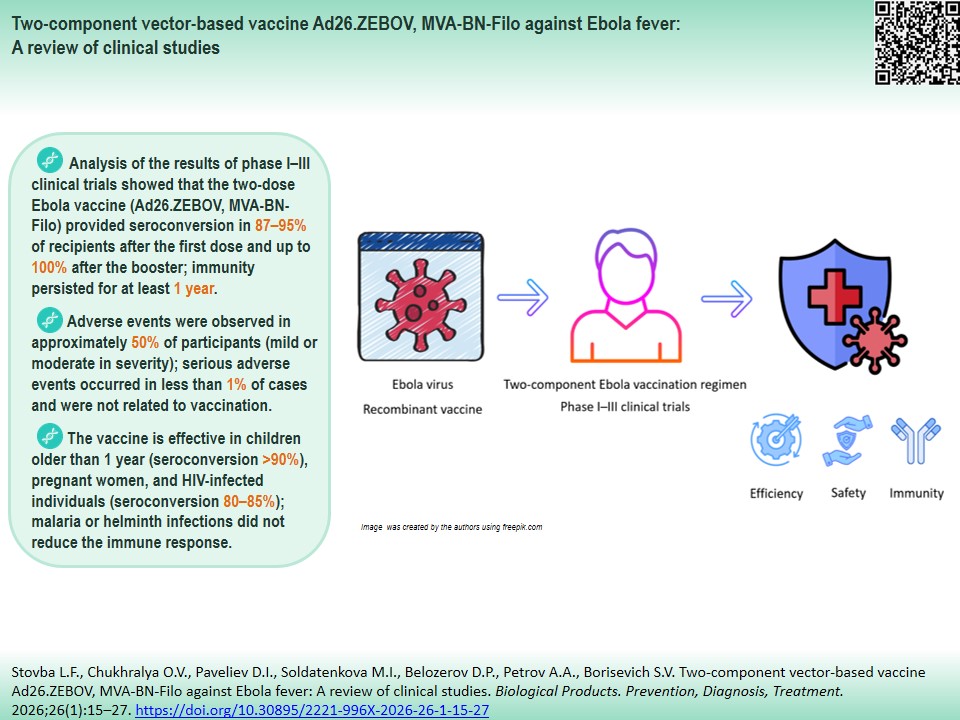
DISCUSSION. Literary sources were analyzed in the PubMed, ScienceDirect, and eLIBRARY.RU databases over the period of 2009–2024. Phase I–III clinical trials confirmed that the twocomponent Ebola vaccination regimen (Ad26.ZEBOV, MVA-BN-Filo) provides a strong and sustained immune response. Seroconversion reached 87–95% three weeks after the first administration and up to 100% after revaccination, with immunity lasting for at least a year. Adverse events (local and systemic, mild to moderate severity) were observed in half of the participants; serious adverse events were not associated with vaccination and occurred in less than 1%. In pregnant women, the vaccination did not increase the risk of adverse outcomes while ensuring the transmission of antibodies to the fetuses. In children and adolescents, seroconversion exceeded 90%; revaccination significantly enhanced the immune response. In HIV-infected individuals, seroconversion reached 80–85%, which is comparable to the general population. Malaria or helminthiasis did not reduce the immunization effectiveness. Considering the above, the World Health Organization and the European Medicines Agency approved this vaccination schedule in 2020 in adults and children over one year of age, including those with concomitant infections.
CONCLUSIONS. The two-component Ad26.ZEBOV, MVA-BN-Filo vaccine shows high immunogenicity and a good safety profile. The primary and booster vaccination schedule is effective in adults, children over one year of age, pregnant women, and individuals with concurrent infections, including HIV, malaria, and helminthiasis. The vaccine reduces the risk of Ebola transmission and can be used for a mass immunization strategy in endemic regions and during the disease outbreaks.
About the Authors
L. F. Stovba
48th Central Scientiffc Research Institute
Russian Federation
Russian Federation
Lyudmila F. Stovba, Cand. Sci. (Biol.)
11 Oktyabrskaya St., Sergiev Posad-6, Moscow Region 141306
O. V. Chukhralya
48th Central Scientiffc Research Institute
Russian Federation
Russian Federation
Oleg V. Chukhralya, Cand. Sci. (Med.)
11 Oktyabrskaya St., Sergiev Posad-6, Moscow Region 141306
D. I. Paveliev
48th Central Scientiffc Research Institute
Russian Federation
Russian Federation
Dmitry I. Paveliev, Cand. Sci. (Med.)
11 Oktyabrskaya St., Sergiev Posad-6, Moscow Region 141306
M. I. Soldatenkova
48th Central Scientiffc Research Institute
Russian Federation
Russian Federation
Maria I. Soldatenkova
11 Oktyabrskaya St., Sergiev Posad-6, Moscow Region 141306
D. P. Belozerov
48th Central Scientiffc Research Institute
Russian Federation
Russian Federation
Dеnis P. Belozerov
11 Oktyabrskaya St., Sergiev Posad-6, Moscow Region 141306
A. A. Petrov
48th Central Scientiffc Research Institute
Russian Federation
Russian Federation
Alexander A. Pеtrov, Dr. Sci. (Med.)
11 Oktyabrskaya St., Sergiev Posad-6, Moscow Region 141306
S. V. Borisevich
48th Central Scientiffc Research Institute
Russian Federation
Russian Federation
Sergey V. Borisevich, Dr. Sci. (Biol.), Prof., Acad. RAS
11 Oktyabrskaya St., Sergiev Posad-6, Moscow Region 141306
References
1. Dembek Z, Kortepeter MG, Pavlin JA, et al. Ebola virus disease outbreaks: Lessons learned from past and facing future challenges. Mil Med. 2024;189(7–8):e1470–8. https://doi.org/10.1093/milmed/usae204
2. Coller B-A, Lapps W Jr, Yunus M, et al. Lessons learned from the development and roll-out of the rVSVΔG-ZEBOV-GP Zaire ebolavirus vaccine to inform Marburg virus and Sudan ebolavirus vaccines. Vaccines (Basel). 2022;10(9):1446. https://doi.org/10.3390/vaccines10091446
3. Agnandji ST, Huttner A, Zinser M, et al. Phase I trials of rVSV Ebola vaccine in Africa and Europe. N Engl J Med. 2016;374(17):1647–56. https://doi.org/10.1056/NEJMoa1502924
4. PREVAC Study Team, Kieh M, Richert L, Beavogui AH, et al. Randomized trial of vaccines for Zaire Ebola virus disease. N Engl J Med. 2022;387(26):2411–24. https://doi.org/10.1056/NEJMoa2200072
5. Chang J. Adenovirus vectors: Excellent tools for vaccine development. Immune Netw. 2021;21(1):e6. https://doi.org/10.4110/in.2021.21.e6
6. Stovba LF, Chukhralya OV, Chernikova NK, et al. Safety and immunogenicity of IMVAMUNE®, a third-generation vaccine based on the modified vaccinia Ankara (MVA) strain. Biological Products. Prevention, Diagnosis, Treatment. 2023;23(1):26–41 (In Russ.). https://doi.org/10.30895/2221-996X-2023-23-1-26-41
7. Stovba LF, Chukhralya OV, Paveliev DI, et al. Comparison of the efficacy of different schemes for using recombinant vector vaccines against Ebola fever, based on Vaccinia virus, MVA strain. Problems of Particularly Dangerous Infections. 2023;(4):24–31 (In Russ.). https://doi.org/10.21055/0370-1069-2023-4-24-31
8. Ishola D, Manno D, Afolabi MO, et al. Safety and longterm immunogenicity of the twodose heterologous Ad26.ZEBOV and MVABNFilo Ebola vaccine regimen in adults in Sierra Leone: a combined openlabel, nonrandomised stage 1, and a randomised, doubleblind, controlled stage 2 trial. Lancet Infect Dis. 2022;22(1):97–109. https://doi.org/10.1016/S1473-3099(21)00125-0
9. Chepurnov AA, Chernukhin IV, Ternovoy VA, et al. Attempts to develop a vaccine against Ebola fever. Problems of Virology. 1995;40(6):257–60 (In Russ.). EDN: VVADEW
10. Zhu W, Banadyga L, Emeterio K, et al. The roles of Ebola Virus soluble glycoprotein in replication, pathogenesis, and countermeasure development. Viruses. 2019;11(11):999. https://doi.org/10.3390/v11110999
11. Volchkova VA, Dolnik O, Martinez MJ, et al. Genomic RNA editing and its impact on Ebola virus adaptation during serial passages in cell culture and infection of guinea pigs. Jnfect Dis. 2011;204(Suppl. 3):S941–6. https://doi.org/10.1093/infdis/jir321
12. Kachikis A, Englund JA. Maternal immunization: optimizing protection for the mother and infant. J Infect. 2016;72(Suppl):S83–90. https://doi.org/10.1016/j.jinf.2016.04.027
13. Calvert A, Jones CE. Placental transfer of antibody and its relationship to vaccination in pregnancy. Curr Opin Infect Dis. 2017;30(3):268–73. https://doi.org/10.1097/QCO.0000000000000372
14. Karita E, Nyombayire J, Ingabire R, et al. Safety, reactogenicity, and immunogenicity of a 2dose Ebola vaccine regimen of Ad26.ZEBOV followed by MVABNFilo in healthy adult pregnant women: study protocol for a phase 3 openlabel randomized controlled trial. Trials. 2022;23(1):513. https://doi.org/10.1186/s13063-022-06360-3
15. Barry H, Mutua G, Kibuuka H, et al. Safety and immunogenicity of 2 dose heterologous Ad26.ZEBOV, MVABNFilo Ebola vaccination in healthy and HIVinfected adults: a randomised, placebocontrolled Phase II clinical trial in Africa. PLoS Med. 2021;18(10):e1003813. https://doi.org/10.1371/journal.pmed.1003813
16. Mwesigwa B, Sawe F, Oyieko J, et al. Safety and immunogenicity of accelerated heterologous-dose Ebola vaccine regimens in adults with and without HIV in Africa. Clin Infect Dis. 2024;79(4):888–900. https://doi.org/10.1093/cid/ciae215
17. McLean C, Dijkman K, Gaddah A, et al. Persistence of immunological memory as a potential correlate of longterm, vaccineinduced protection against Ebola virus disease in humans. Front Immunol. 2023;14:1215302. https://doi.org/10.3389/fimmu.2023.1215302
18. Portugal S, Tipton CM, Sohn H, et al. Malaria-associated atypical memory B cells exhibit markedly reduced B cell receptor signaling and effector function. eLife. 2015;4:e07218. https://doi.org/10.7554/eLife.07218
19. Nakalembe M, Banura C, Namujju PB, Mirembe FM. Immunogenicity to the bivalent HPV16/18 vaccine among adolescent African students exposed to helminths and malaria. J Infect Dev Ctries. 2015;9(2):197–205. https://doi.org/10.3855/jidc.5719
20. Mahon BE, Simon J, Widdowson MA, et al. Baseline asymptomatic malaria infection and immunogenicity of recombinant vesicular stomatitis virus — Zaire Ebola virus envelope glycoprotein. J Infect Dis. 2021;224(11):1907–15. https://doi.org/10.1093/infdis/jiab243
21. Ishola D, EBOVAC Salone Malaria Infection Sub Study Team. Asymptomatic malaria infection and the immune response to the 2 dose Ad26.ZEBOV, MVA BN Filo Ebola vaccine regimen in adults and children. Clin Infect Dis. 2022;75(9):1585–93. https://doi.org/10.1093/cid/ciac209
22. Manno D, Patterson C, Drammeh A, et al. The effect of previous exposure to malaria infection and clinical malaria episodes on the immune response to the twodose Ad26.ZEBOV, MVABNFilo Ebola vaccine regimen. Vaccines. 2023;11(8):1317. https://doi.org/10.3390/vaccines11081317
23. Cooper PJ, Chico M, Sandoval C, et al. Human infection with Ascaris lumbricoides is associated with suppression of the interleukin2 response to recombinant cholera toxin B subunit following vaccination with the live oral cholera vaccine CVD 103HgR. Infect Immun. 2001;69(3):1574–80. https://doi.org/10.1128/IAI.69.3.1574-1580.2001
24. Loukouri A, Méité A, Kouadio OK, et al. Prevalence, intensity of soiltransmitted helminths, and factors associated with infection: importance in control program with ivermectin and albendazole in eastern Côte d’Ivoire. J Trop Med. 2019;2019:7658594. https://doi.org/10.1155/2019/7658594
25. Barry H, Lhomme E, Surénaud M, et al. Helminth exposure and immune response to the twodose heterologous Ad26.ZEBOV, MVABNFilo Ebola vaccine regimen. PLoS Negl Trop Dis. 2024;18(4):e0011500. https://doi.org/10.1371/journal.pntd.0011500
26. Manno D, Bangura A, Baiden F, et al. Safety and immunogenicity of an Ad26.ZEBOV booster dose in children previously vaccinated with the twodose heterologous Ad26.ZEBOV and MVABNFilo Ebola vaccine regimen: an openlabel, nonrandomised, phase 2 trial. Lancet Infect Dis. 2023;23(3):352–60. https://doi.org/10.1016/S1473-3099(22)00594-1
27. Afolabi MO, Ishola D, Manno D, et al. Safety and immunogenicity of the twodose heterologous Ad26.ZEBOV and MVABNFilo Ebola vaccine regimen in children in Sierra Leone: A randomised, doubleblind, controlled trial. Lancet Infect Dis. 2022;22(1):110–22. https://doi.org/10.1016/S1473-3099(21)00128-6
28. Anywaine Z, Barry H, Anzala O, et al. Safety and immunogenicity of 2dose heterologous Ad26.ZEBOV, MVABNFilo Ebola vaccination in children and adolescents in Africa: A randomised, placebocontrolled, multicentre phase II clinical trial. PLoS Med. 2022;19(1):e1003865. https://doi.org/10.1371/journal.pmed.1003865
29. Choi EML, Lacarra B, Afolabi MO, et al. Safety and immunogenicity of the twodose heterologous Ad26.ZEBOV and MVABNFilo Ebola vaccine regimen in infants: a phase 2, randomized, doubleblind, activecontrolled trial in Guinea and Sierra Leone. Lancet Glob Health. 2023;11(11):e1743–52. https://doi.org/10.1016/S2214-109X(23)00410-2
30. Julien N, Rosine I, Ben M, et al. Monitoring of adverse events in recipients of the 2dose Ebola vaccine regimen of Ad26.ZEBOV followed by MVABNFilo in the UMURINZI Ebola vaccination campaign. J Infect Dis. 2023;227(2):268–77. https://doi.org/10.1093/infdis/jiac283
Review
For citations:
Stovba L.F., Chukhralya O.V., Paveliev D.I., Soldatenkova M.I., Belozerov D.P., Petrov A.A., Borisevich S.V. Two-component vector-based vaccine Ad26.ZEBOV, MVA-BN-Filo against Ebola fever: A review of clinical studies. Biological Products. Prevention, Diagnosis, Treatment. 2026;26(1):15-27. (In Russ.) https://doi.org/10.30895/2221-996X-2026-26-1-15-27
Views:
851
JATS XML





 Email this article